Joi meaning slang is a search that usually starts with a small moment of confusion.
You spot “JOI” in a comment, a username, a tag, or a message, and you can’t tell if it’s a name, a movie reference, or something you shouldn’t open at work.
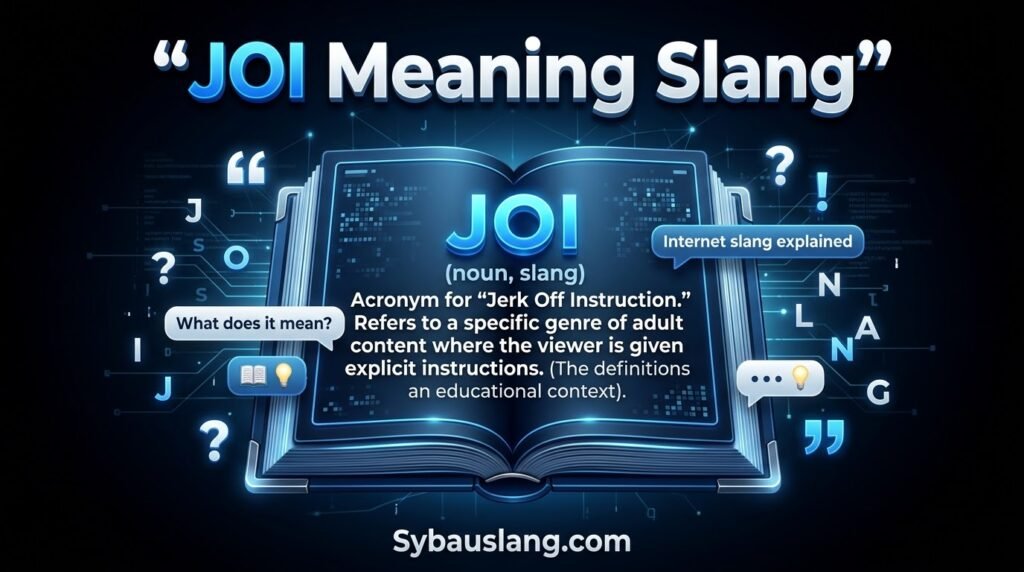
In slang, JOI almost always stands for “jerk off instruction,” an adult-content term. It also has a few harmless meanings, depending on context.
This guide explains each one clearly and without drama. It also covers how to tell them apart and what to do next.
Table of Contents
Quick Table: JOI Meaning Slang at a Glance
| Topic | Meaning / Purpose | Best For | Style / Type | Useful Tip |
|---|---|---|---|---|
| JOI (slang, most common) | Short for “jerk off instruction,” an adult content genre | Adults who need to decode what they’re seeing | Internet acronym, NSFW | Treat it as adult content unless context clearly says otherwise |
| Joi (Blade Runner 2049) | A holographic AI companion character | Movie fans, sci-fi discussions | Pop culture reference | Look for film or actor names nearby |
| Joi (given name) | A first name or nickname, often pronounced “joy” | Anyone meeting a person with that name | Personal name | Check if it’s capitalized and used like a name |
| Joi (spelling of “joy”) | Playful or stylized spelling | Brands, usernames, captions | Stylized text | Look for cheerful, positive context |
| JOI (other initials) | Initials for organizations or journals | Academic or business readers | Abbreviation | Check the surrounding field or industry |
| JOI in tags or hashtags | A label for adult content on some platforms | Parents, moderators, platform users | NSFW tag | Use filters and safe-search settings |
| JOI in DMs or comments | Could be spam, bait, or a real adult request | Anyone receiving unexpected messages | Direct messaging | Don’t click unknown links; block and report |
What Does JOI Mean in Slang?
In internet slang, JOI means “jerk off instruction.” It describes a type of adult content in which a performer speaks directly to the viewer or listener and guides them through a solo sexual act.
It can come as video, audio, or text, and it’s almost always labeled NSFW (not safe for work).
That’s the whole definition in one line. It’s an adult-only term, which is why it often shows up with age warnings, content filters, or blurred previews.
Some quick points about the term:
- It’s an initialism, which means each letter stands for a word.
- It’s usually written in capitals (JOI), though you’ll see “joi” in lowercase in casual typing.
- It’s pronounced the way you’d say the word “joy.”
- It’s not a general-purpose texting abbreviation like LOL or BRB. You won’t hear it in everyday conversation among most people, and it isn’t meant for polite company.
If you’re here because you saw it in a message from someone you know, the context sections below will help you work out what’s going on.
Why Do People Search for Joi Meaning Slang?
Most people who look this up aren’t searching for adult content. They want a quick answer to a simple question. Here are the usual reasons.
1. They saw it in a comment section or a tag.
Adult acronyms leak into mainstream spaces all the time. A comment under a meme, a reply on a social post, or a stray tag can leave you puzzled.
2. They got an unexpected message.
Spam accounts and bots sometimes use adult terms to bait clicks. People then search the term to figure out whether the message is a joke, a scam, or something else.
3. They’re a parent or guardian.
If a teenager’s browser history, chat, or screen shows an unfamiliar acronym, a parent may look it up quickly to decide how to respond.
4. They mixed it up with the movie.
Many people first heard the name “Joi” through Blade Runner 2049 and are surprised that the same letters mean something different online.
5. They’re curious about internet language in general.
Slang changes fast, and plenty of people simply like knowing what words mean.
Knowing why you’re searching helps you choose the right section of this article. Skip ahead if you need to.
The Origin of JOI as Slang
There’s no single documented moment when “JOI” was invented, and anyone who claims a precise date is guessing. What we can say is how it spread.
Adult content creators and communities have long used short labels to sort their material. Initialisms are efficient:
they fit in a title, a tag, or a username, and they help viewers find the exact category they want. Online forums, image boards, and video platforms all developed their own shorthand this way.
As adult content moved onto social media, subscription sites, and short-form video, the shorthand traveled with it.
Tags that once lived only on dedicated adult sites started to appear in comments, bios, and search suggestions on mainstream platforms. That’s how a niche acronym ended up in front of people who never went looking for it.
Two things helped it spread:
- Algorithmic recommendations. Platforms sometimes surface related tags or search suggestions that expose people to unfamiliar terms.
- Meme culture. Once a term is widely known, people use it as a joke, sometimes in contexts that have nothing to do with the original meaning.
The result is that the term is now recognizable even to people who don’t use adult sites at all.
Other Meanings of Joi You Might Run Into
Not every “Joi” is adult slang. Because the letters are short and the sound matches a common word, several other meanings exist. Here are the ones you’re most likely to meet.
Joi in Blade Runner 2049
In the 2017 film Blade Runner 2049, Joi is a holographic AI companion sold as a product. She’s played by Ana de Armas and is closely tied to the main character, Officer K.
The film uses her to explore questions about artificial companionship, memory, and what counts as real affection.
If someone says “Joi” while talking about sci-fi, neon cityscapes, androids, or Ryan Gosling’s character, they almost certainly mean the film character. Fans write essays, make fan art, and discuss her storyline online, so you’ll see the name in plenty of perfectly family-friendly spaces.
Because the character is a companion product, some online jokes mix the movie reference with the slang meaning. Still, a movie discussion is just a movie discussion unless the surrounding text clearly points elsewhere.
Joi as a Given Name or Nickname
“Joi” is also a real name. People use it as a first name or a nickname, and it’s usually pronounced like “joy.” A well-known example is Joi Ito, a Japanese-born technologist and writer. Other people named Joi appear in entertainment, business, and everyday life.
If you see “Joi” with a capital J, followed by a last name, or used in a greeting like “Hey Joi, thanks for the help,” it’s a person’s name.
Joi as a Playful Spelling of “Joy”
Some brands, creators, and everyday users deliberately spell “joy” as “joi” for style. You’ll see it in product names, usernames, café signs, and captions. In these cases the mood is positive: celebration, happiness, small wins.
Joi in Other Languages and Wordplay
The letters appear in other languages and in the French phrase joie de vivre (“joy of living”). These uses are separate from the slang and are usually obvious from the language around them.
JOI as Other Initials
In professional or academic settings, JOI can also stand for the initials of an organization, a journal, or a project name. In those cases it sits next to formal text, citations, or company information.
It’s rarely confused with the slang because the setting is so different.
How to Tell Which JOI Meaning Someone Is Using
Context decides almost everything. Before you assume the worst or the best, check a few things.
Check the Platform
- Adult platforms, age-gated pages, or NSFW communities: the slang meaning is almost certain.
- Movie forums, fan wikis, or entertainment sites: probably the film character.
- Professional networks or workplace chats: more likely a name or an organization’s initials.
- General social media comments: could be anything, so look at the wording around it.
Check the Capitalization
- “JOI” in all capitals often signals the acronym, though not always.
- “Joi” with only the first letter capitalized often points to a name or the character.
- “joi” in lowercase is ambiguous and needs other clues.
Check the Neighboring Words
Words like “NSFW,” “18+,” “link in bio,” “DM me,” or “subscribe” nearby suggest an adult context. Words like “Ana de Armas,” “Blade Runner,” “hologram,” or “AI companion” point to the film. A greeting or a thank-you suggests a person.
Check Who Is Writing
A message from a close friend, a coworker, or a family member is very unlikely to be the adult slang unless the conversation already involves adult topics. An unfamiliar account sending a cryptic message with a link is much more likely to be spam or bait.
A Quick Context Table
| Clue You See | Likely Meaning |
|---|---|
| NSFW warning, 18+ label, age gate | Adult slang |
| Mentions of the film, hologram, Ana de Armas | Blade Runner 2049 character |
| Used as a greeting or with a last name | A person’s name |
| Cheerful caption, brand, or product text | Stylized “joy” |
| Formal text, journal, or company details | Initials for an organization or publication |
| Random account, odd link, urgent tone | Possible spam or scam |
JOI Meaning Slang on Social Media and Messaging Apps
The term shows up in several places, and each behaves a little differently.
Comments and Replies
On public posts, you might see the term in a reply from a bot or from someone trying to be provocative. Many of these accounts exist only to push people toward outside links.
Usernames and Bios
Some accounts put adult acronyms in their usernames or bios to signal what they post. Platforms often have rules about this, and accounts that break them can be restricted.
Direct Messages
Unexpected DMs mentioning the term are a common spam tactic. The message may include a link or ask you to move to another app. Treat these with suspicion.
Tags and Hashtags
On platforms that allow adult content, creators tag it so viewers can filter or avoid it. On platforms that don’t, the tag can still appear, and moderators may remove it.
Group Chats
Occasionally a friend will use the term as a joke. If you don’t understand it, it’s perfectly fine to ask, or to look it up privately like you’re doing now.
Related Terms and Variations You May See
Searchers often type related phrases alongside the main keyword. Here’s how they connect.
- JOI meaning in text: the same slang meaning applies. In text messages, the context and the sender matter most.
- JOI meaning in chat or on Snapchat, TikTok, Instagram: the term can show up on any platform, but most mainstream apps restrict adult content and may remove or limit it.
- JOI full form: “jerk off instruction” for the slang. For other uses, the full form depends on the organization.
- JOI slang vs. ASMR: ASMR is about relaxing sounds and gentle triggers, and most of it isn’t adult. Some adult content borrows ASMR-style audio, but the two are different categories.
- NSFW: a general warning label for anything unsuitable for work or public viewing. JOI content falls under it.
- SFW: “safe for work,” the opposite of NSFW.
- Joi AI: this usually refers to the Blade Runner 2049 character or to AI companion products that borrow the name. It’s not the same as the slang unless the context says so.
- Joi name meaning: as a name, it’s commonly linked to the idea of joy.
- Joi pronunciation: “joy.”
Keep in mind that some phrases mix the film and the slang because people play on the character’s role as a companion. When you see an overlap, look at how serious or jokey the writing is.
Real-Life Style Scenarios
Examples make this easier to remember. Here are some everyday situations and how to read them.
Scenario 1: A stranger comments “JOI in my bio” under a cooking video.
This is almost certainly a spam or promotion account. The comment has nothing to do with cooking and pushes you toward a profile. Don’t click. Report the comment if the platform allows it.
Scenario 2: Your coworker writes, “Have you seen Joi’s presentation yet?”
That’s a person’s name. Nothing to worry about.
Scenario 3: A friend posts, “Just rewatched Blade Runner 2049, Joi’s storyline is so sad.”
This refers to the film character. The conversation is about cinema and story.
Scenario 4: A teenager’s browser history shows a search for the term.
Teens often search unfamiliar words out of curiosity after seeing them in a game chat, a comment section, or a friend’s joke. A calm conversation works better than panic. More on this below.
Scenario 5: You get a text from an unknown number: “Want JOI? Click here.”
That’s a scam or spam attempt. Delete it, block the number, and avoid the link.
Scenario 6: A café called “Joi Coffee” opens near you.
A stylized spelling of “joy.” It’s a branding choice and nothing more.
Scenario 7: A friend jokingly uses the term in a group chat.
It may be an inside joke, but if it makes you uncomfortable, you can say so. You’re allowed to ask people to keep adult jokes out of a shared space.
Scenario 8: A research paper cites “JOI” in its references.
It’s probably the initials of a journal or organization. The academic context makes this clear.
Scenario 9: A game streamer’s chat fills with the term.
Some chat rooms get flooded by trolls or bots using adult terms. Moderators usually remove these messages, and you can report them.
Scenario 10: A classmate says it at school.
Students sometimes repeat slang they don’t fully understand. A short, calm explanation of why it’s inappropriate in school is usually enough.
Why This Slang Matters: Safety and Awareness
It might seem odd to spend this much time on a single acronym. But understanding it helps in several practical ways.
Protecting Younger Users
Adult terms in the wrong hands, or on the wrong screens, can lead children and teens toward content they aren’t ready for. Knowing the term helps parents and teachers recognize warning signs and step in early.
Spotting Scams
Many spam campaigns reuse popular adult terms. Understanding the term makes it easier to recognize bait and avoid harm, including phishing links and fake payment requests.
Keeping Professional Spaces Appropriate
If you manage a workplace chat, a community group, or a school forum, you may need to moderate language. Knowing what a term means helps you apply your rules fairly.
Reducing Embarrassment
Few things feel worse than repeating a phrase in the wrong setting because you didn’t know what it meant. A quick check saves you from awkward moments.
A Note for Parents, Guardians, and Teachers
If a young person in your life has come across this term, here’s a calm way to handle it.
Stay calm. Curiosity about words is normal. A strong reaction can make a young person hide what they see online rather than come to you.
Ask open questions. Something like, “Where did you see that?” works better than “Why were you looking at that?”
Explain simply. You don’t need graphic detail. A short, honest answer works: it’s an adult term connected to adult content, and it isn’t meant for kids.
Set expectations. Talk about age limits, why they exist, and why some content is meant for adults only.
Use tools. Safe-search settings, parental controls, and age-appropriate app settings help limit exposure. No tool is perfect, so keep talking, too.
Keep the door open. Let them know they can come to you if they see something confusing or upsetting, without getting in trouble.
Know where to report. Most platforms have a report button for inappropriate content or messages. If an adult is contacting a minor with sexual content, report it to the platform and to local authorities.
Teachers can follow similar steps. Keep it brief, factual, and consistent with school policy.
A Note for Adults Who Encounter the Term
Adults are free to make their own choices about what they view, but a few common-sense points still apply.
- Consent and age matter. Reputable adult platforms require that everyone involved is an adult and has consented. Avoid anything that doesn’t clearly meet that standard.
- Privacy matters. Be careful with personal information, payment details, and photos. Scammers target people who look for adult content.
- Mind your setting. Don’t open adult content on a work device, in public, or around children.
- Watch for fake offers. Free “special content” links in DMs are often scams or malware traps.
- Respect others. Don’t send adult material to anyone who hasn’t asked for it. In many places, doing so is harassment and can break the law.
Common Mistakes People Make With the Term
A few errors come up again and again. Avoiding them saves time and trouble.
Mistake 1: Assuming Every “Joi” Is Adult Slang
A person named Joi, a café, or a movie character isn’t related to the acronym. Check context before jumping to conclusions. Misreading a harmless name can cause real awkwardness.
Mistake 2: Assuming It’s Always Harmless
The opposite error is just as common. People see an unfamiliar acronym and assume it’s a quirky abbreviation. If it appears in a suspicious DM or next to an unknown link, take it seriously.
Mistake 3: Clicking Links to “Find Out”
Curiosity gets many people into trouble. Search engines and dictionaries can give you the meaning without any risk. Never click an unknown link just to learn what a word means.
Mistake 4: Using It in the Wrong Setting
Dropping the term into a school group, a family chat, or a work thread can cause embarrassment or even disciplinary trouble. It’s an adult term, and it belongs only in adult contexts.
Mistake 5: Confusing It With ASMR or Roleplay Content
People sometimes lump unrelated genres together. ASMR is mostly about relaxation sounds. Roleplay videos cover many themes. The term here refers to a specific adult category, so don’t treat them as the same thing.
Mistake 6: Overreacting When a Child Sees It
Alarm tends to make young people secretive. Respond with calm guidance and clear boundaries instead of punishment.
Mistake 7: Trusting Unknown Accounts That Use the Term
Accounts that push adult acronyms to strangers are often bots or scammers. Don’t send money, photos, or personal details to someone you met this way.
Mistake 8: Forgetting to Report Inappropriate Messages
If you receive unwanted adult content, reporting it helps platforms remove bad accounts. Ignoring it leaves the problem for the next person.
Mistake 9: Relying on Unreliable Sources
Some websites gather slang definitions with little accuracy. Use reputable dictionaries, established reference sites, or well-moderated sources when you want a trustworthy answer.
Mistake 10: Not Checking Spelling and Capitalization
“JOI,” “Joi,” and “joi” can mean different things. Paying attention to the way it’s written, along with the surrounding words, gives you better clues.
How to Figure Out What “JOI” Means in a Message You Received
Use this simple step-by-step approach whenever you’re unsure.
Step 1: Pause before replying.
You don’t owe anyone an instant answer, especially if the message makes you uneasy.
Step 2: Look at the sender.
Is it a friend, coworker, or relative? Or an unknown account with no history?
Step 3: Read the full message.
Look for context words such as a movie title, a name, a link, or a request.
Step 4: Check for red flags.
Urgent language, odd links, requests for money, or pressure to switch apps all point to a scam.
Step 5: Look up the term privately.
Use a trusted dictionary or search engine, not a link from the message.
Step 6: Decide how to respond.
If it’s a friend and you’re unsure, ask what they meant. If it’s a stranger, ignore, block, and report.
Step 7: Save evidence if needed.
If the message is harassing, screenshot it before blocking so you can report it properly.
Practical Tips for Handling the Term
Here are quick, actionable ideas you can use right away.
- Use safe-search settings on your browser and your children’s devices to reduce accidental exposure.
- Turn on content filters in apps that offer them, and set age-appropriate restrictions.
- Mute or block keywords on platforms that let you filter comments and messages.
- Never click unknown links in DMs, even if they look harmless.
- Report spam accounts instead of just ignoring them.
- Ask a trusted person when you’re unsure about a message, especially if you’re young.
- Keep conversations open at home so young people feel safe asking questions.
- Check privacy settings so strangers can’t easily message you or your children.
- Use reputable references for slang definitions rather than random forums.
- Keep adult topics out of shared spaces such as school groups, workplace chats, and family threads.
- Think about your digital footprint. What you search for and share can stay with you.
- Update passwords and enable two-factor authentication if you’ve clicked a suspicious link.
Example Sentences Showing Different Meanings (All Safe-for-Work)
Seeing the word used in sentences helps you tell the meanings apart. These samples are all family-friendly.
Name:
- “Joi is leading the team meeting this afternoon.”
- “I texted Joi to ask about the schedule.”
Film character:
- “The scene where Joi talks to K is one of the most discussed in the movie.”
- “People still debate whether Joi’s feelings in the film were real.”
Stylized “joy”:
- “That bakery’s slogan is ‘Bake with joi.'”
- “She named her art studio Joi because it makes her happy.”
Slang (explained, not demonstrated):
- “He asked what JOI meant after seeing it in a spam comment, and his sister told him it’s an adult term he should ignore.”
- “The moderator removed the post because it used adult slang and violated the group’s rules.”
Initials:
- “The article was published in a journal abbreviated JOI in the reference list.”
JOI Meaning Slang vs. Similar Online Terms
People often mix up internet terms, so here’s a quick comparison.
| Term | What It Means | Adult Content? | Common Setting |
|---|---|---|---|
| JOI (slang) | Jerk off instruction | Yes | Adult sites and tags, spam |
| NSFW | Not safe for work, a general warning | Sometimes | Any platform |
| SFW | Safe for work | No | Any platform |
| ASMR | Autonomous sensory meridian response, relaxing sounds | Usually no | Video platforms |
| GFE | “Girlfriend experience,” a type of companionship service or roleplay | Sometimes | Creator platforms |
| Joi (film) | AI companion in Blade Runner 2049 | No | Movie discussions |
| Joi (name) | A person’s name | No | Everyday life |
The table shows why context matters so much. Several terms sit close together online, but they’re not interchangeable.
How Platforms and Search Engines Treat the Term
Most large platforms have rules about adult content. These rules typically include:
- Age verification for access to adult material.
- Content labels such as NSFW tags.
- Restrictions on promotion so adult accounts can’t advertise freely to the general public.
- Reporting tools for flagged content.
Search engines often blur or filter adult results when safe-search is on. If you search for the term with safe-search enabled, you’ll usually get dictionary-style or explanatory pages instead of explicit material. That’s a good reason to keep safe-search turned on, especially on shared or family devices.
Advertisers also tend to avoid adult terms, which is why pages that explain slang in a neutral, educational way, like this one, are treated differently from adult content pages.
Why Slang Like This Keeps Changing
Internet slang moves quickly. A term can start in a small community, spread through memes, and reach the mainstream within months. Others fade just as fast.
A few things drive this:
- Platform culture. Each app develops its own shorthand.
- Moderation and workarounds. When platforms ban words, users invent new spellings and acronyms to get around filters. That’s one reason a word can appear in odd forms, like “j0i” or extra punctuation.
- Humor. Memes take serious terms and flip them into jokes, shifting how people use them.
- Age groups. Younger users often adopt new terms faster, and older users catch up later.
If you want to stay informed without going down a rabbit hole, bookmark a couple of reliable slang dictionaries and check them when a new term appears.
Expert-Style Advice: Staying Calm and Informed
People who work in online safety, education, and community moderation tend to give similar guidance.
Focus on patterns, not single words. One odd acronym in a comment doesn’t mean much on its own. A pattern of strange messages, links, and pressure is what signals a real problem.
Teach the habit of pausing. Whether you’re a teenager or a grandparent, stopping to ask “Who sent this and why?” prevents most online mishaps.
Normalize asking. People who feel safe asking questions are much less likely to get into trouble secretly.
Treat privacy as a daily habit. Use strong passwords, limit what you share publicly, and review friend lists and followers regularly.
Keep your own boundaries clear. You never have to respond to a message, join a conversation, or open a link that makes you uncomfortable.
Frequently Asked Questions About Joi Meaning Slang
1. What does JOI mean in slang?
In slang, JOI stands for “jerk off instruction,” an adult content category where a performer guides a viewer or listener. It’s labeled NSFW and meant only for adults. Other meanings, like a person’s name or a film character, exist, so context matters.
2. Is JOI a bad word?
The acronym itself isn’t a swear word, but it refers to adult content, so it isn’t appropriate for school, work, or family settings. Treat it as an adult term and avoid using it around children or in professional spaces.
3. What does JOI mean in text messages?
In a text, the slang meaning applies only if the conversation is already about adult topics. If it comes from a friend, ask what they meant. If it comes from an unknown number with a link, it’s most likely spam, so don’t click and block the sender.
4. Is Joi from Blade Runner 2049 related to the slang?
They’re separate. The character is a holographic AI companion in the 2017 film, played by Ana de Armas. Some people make jokes that blend the two, but a movie conversation is just a movie conversation unless the wording clearly points elsewhere.
5. How do you pronounce JOI?
It’s pronounced like the word “joy.” That’s true whether it’s the acronym, the film character, a name, or a stylized spelling of “joy.”
6. Why am I seeing JOI in my comments or messages?
Spam accounts and bots often use adult acronyms to attract attention and push people toward outside links. If you didn’t ask for this content, don’t engage. Report the comment or message, then block the account.
7. Should I be worried if my child searched for it?
Not necessarily. Children often look up words they overhear or see in comments. Stay calm, ask where they saw it, and give a simple, age-appropriate explanation. Then review safe-search settings and parental controls, and keep the conversation open.
8. Can JOI mean something else besides the adult slang?
Yes. It can be a first name or nickname, the AI character in Blade Runner 2049, a stylized spelling of “joy,” or initials for an organization or journal. Check the platform, capitalization, and neighboring words to decide which one fits.
9. Is it safe to search for the meaning?
Looking up the definition is safe, especially with safe-search turned on and a reputable source. The risk comes from clicking unknown links, opening adult sites on shared devices, or following suspicious messages. Stick to dictionaries and explanatory articles.
10. How can I block or avoid this kind of content?
Turn on safe-search in your browser and search engine, use the content filters and restricted modes in your apps, mute keywords in comments and messages, and tighten privacy settings so strangers can’t contact you easily. On children’s devices, add parental controls and review them from time to time.
Conclusion
Joi meaning slang comes down to one main answer and a handful of side answers. Online, JOI usually stands for “jerk off instruction,” an adult-only content label that doesn’t belong in school, work, or family spaces.
But the same letters can also point to a character in Blade Runner 2049, a person named Joi, a playful spelling of “joy,” or initials for a journal or organization. The word alone rarely tells you which one you’re looking at.
That’s why the best habit is to read the clues. Check the platform, the capitalization, the words around it, and who sent it.
If something feels off, whether it’s a strange link, an urgent tone, or a message from an account you don’t know, pause before you respond. Blocking and reporting cost you nothing.
For parents and teachers, a calm, honest conversation does more than any filter. Keep the tone open, give short and clear answers, and pair your talks with sensible settings. For everyone else, safe-search, keyword muting, and good privacy habits will cover most situations.
Slang will keep changing, and new terms will keep showing up in your feed.
When they do, you now have a simple approach: stay curious, check the context, protect your privacy, and ask when you’re unsure. Share this guide with someone who might be searching the same question.