IDTS Meaning slang refers to “I Don’t Think So,” a common abbreviation used in texting, chats, and social media.
People use IDTS when they disagree with something, doubt a statement, or simply want to say “probably not.” For example, if someone asks, “Are you coming tonight?” you might reply, “IDTS.”
The tone can be casual and sometimes slightly dismissive, depending on the conversation. You may see IDTS on platforms like TikTok, Snapchat, Instagram, and in everyday text messages.
Understanding this slang makes online conversations easier, especially when people use short abbreviations instead of full sentences.
Table of Contents
Quick Table
| Term | Meaning |
|---|---|
| IDTS | I Don’t Think So |
| Type | Slang abbreviation |
| Used in | Texting, chats, social media |
| Tone | Casual, doubtful, or dismissive |
| Example | “Are you coming?” — “IDTS.” |
| Similar phrase | Probably not |
| Common platforms | TikTok, Snapchat, Instagram, WhatsApp |
What Does IDTS Mean in Texting?
So last month I was texting my cousin about weekend plans, and I suggested we go check out this new ramen place downtown. She hit me back with “idts, my mom’s making dinner that night.”
I stared at my phone for a solid ten seconds. IDTS? Was that a typo? A new app? Some abbreviation for a restaurant chain I hadn’t heard of?
I typed back “what’s idts” and got a laughing emoji followed by “I Don’t Think So 💀”
That’s it. That’s the whole thing.
And honestly, I felt a little old in that moment, which is wild because I’m not even that old. But texting slang moves fast, and if you’re not deep in group chats with teenagers or scrolling TikTok comments daily, you miss stuff.
So I did what any curious person would do — I went down a rabbit hole trying to figure out where this came from, how people actually use it, and whether I’d been missing other similar abbreviations this whole time. Turns out, yeah, I had.
So What Does IDTS Actually Mean?
IDTS stands for “I Don’t Think So.” That’s the core meaning, plain and simple.
It’s basically a shorthand way of disagreeing with something, declining an idea, or expressing doubt — without typing out the whole phrase.
People use it in texts, DMs, comment sections, and group chats when they want to shut something down quickly but without sounding harsh.
Think of it as the texting cousin of just saying “nah” or “probably not.”
Where I’ve Actually Seen It Used
Once I knew what it meant, I started noticing it everywhere. It’s like when you learn a new word and suddenly hear it in every conversation.
In group chats: Someone suggests a plan — like “should we invite Jake to the party?” — and someone replies “idts, remember what happened last time.” Quick, blunt, done.
In comment sections: Especially on Instagram or TikTok, when someone makes a claim and another person disagrees. Like a comment saying “this diet actually works” and someone replying “idts, there’s no science behind it.”
In casual arguments over text: My roommate used it when I asked if she thought our landlord would fix the AC before summer. “idts, he’s been ignoring us for weeks.”
On Reddit threads: People use it a lot when responding to a post asking “will this happen” or “is this true” type questions. It fits perfectly into that fast, skeptical reply style Reddit is known for.
Why People Use It Instead of Just Saying “No”
Here’s the thing I realized after using it myself for a while — IDTS feels less final than a flat “no.”
Saying “no” can come across kind of cold, especially in text where tone is already hard to read. But “idts” softens it a bit. It reads more like “I doubt it” or “probably not, but I’m not 100% sure.” It leaves a little room.
It’s also just faster to type. In the world of quick replies and disappearing Snapchat messages, saving four words matters more than you’d think.
Common Mistakes People Make With IDTS
I definitely fumbled this a few times after learning it, so let me save you the embarrassment.
Mistake 1: Using it in professional settings. I made this mistake exactly once. I was messaging a coworker on Slack about whether a client would approve a design mockup, and I typed “idts tbh.” She replied with a confused emoji. Slang abbreviations like this belong in casual texting, not work chats — even informal ones. Stick to plain English at work unless your whole team is already using internet shorthand.
Mistake 2: Confusing it with similar abbreviations. There’s a small cluster of texting acronyms that look similar and it’s easy to mix them up:
- IDTS = I Don’t Think So
- IDK = I Don’t Know
- IDC = I Don’t Care
- IDGAF = (I’ll let you guess that one)
I actually typed “idts” once meaning to say I didn’t know, and my friend thought I was disagreeing with her plan when I was just uncertain. Small mix-up, but it caused a confusing five-minute back and forth.
Mistake 3: Overusing it until it loses meaning. If every third text you send is “idts,” people start reading it as a reflex rather than an actual opinion. Use it when you genuinely mean it, not as filler.
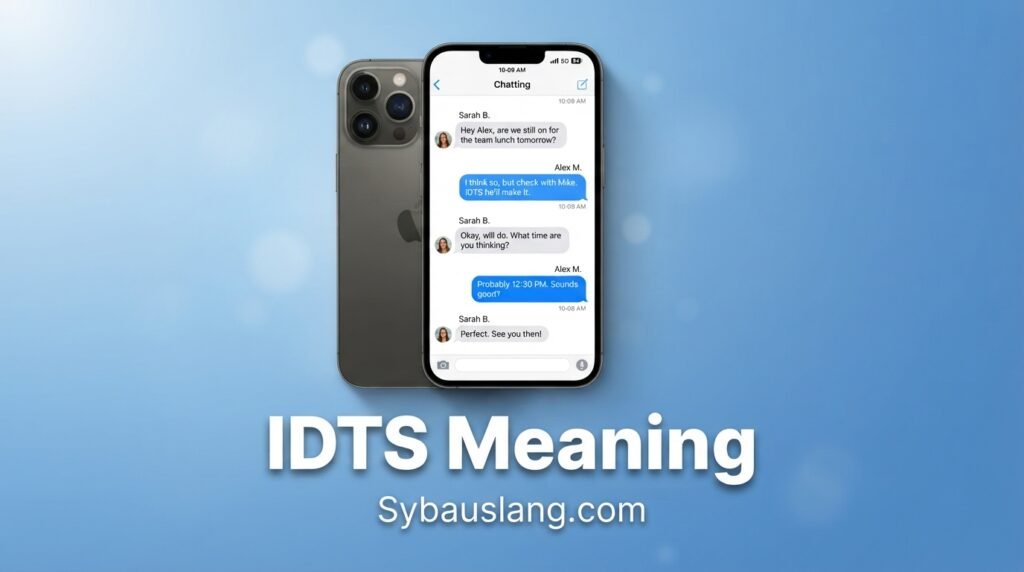
How To Actually Use IDTS Correctly (Step-by-Step)
If you want to start using it naturally instead of forcing it into conversations, here’s how I’d break it down:
Step 1: Use it when you’re expressing doubt, not flat refusal.
If you’re fully against something, just say no or explain why. IDTS works best when you’re unsure or skeptical, not dead set against something.
Step 2: Pair it with a reason when you can.
“idts, it’s supposed to rain” hits better than just “idts” with no context. It shows you’re not just being dismissive.
Step 3: Match the tone of the conversation.
Casual group chat with friends? Perfectly fine. Messaging your professor about a deadline extension? Please don’t.
Step 4: Don’t be afraid to add emojis or punctuation for tone.
“idts 😅” reads differently than just “idts.” The emoji softens it and makes it feel more like a light opinion than a hard no.
Where This Kind of Slang Comes From
From what I found digging around forums and slang dictionaries like Urban Dictionary, IDTS has been floating around texting culture for years, growing alongside other similar acronyms like IDK, TBH, and NGL.
It picked up steam through platforms like Twitter (now X), Discord servers, and group texting apps where speed matters more than full sentences.
Gen Z didn’t necessarily invent the concept of shorthand — remember LOL and BRB from way back — but they’ve expanded the vocabulary massively.
Honestly, it’s kind of fascinating watching language evolve in real time through texting. Every year there’s a new batch of abbreviations, and if you don’t stay a little plugged in, you end up like me — googling “idts meaning” after your cousin roasts you for it.
Other Similar Slang Worth Knowing While You’re At It
Since I went down this rabbit hole anyway, here are a few related ones I picked up that might save you from another confused texting moment:
- IMO / IMHO – In My Opinion / In My Humble Opinion
- NGL – Not Gonna Lie
- TBH – To Be Honest
- FR – For Real
- IYKYK – If You Know You Know
These all show up in the same casual, opinion-sharing context as IDTS, so learning them together just makes sense.
My Honest Take After Using It For A While
At first, I felt like I was forcing myself to use slang I didn’t fully vibe with. But after a few weeks of texting my younger cousins and some coworkers who are a bit more online than me, it started feeling natural.
Now when someone asks if I think a movie will be good, or if a plan will actually happen, “idts” just comes out instead of typing the whole sentence.
It’s efficient, it fits the tone of casual digital conversation, and honestly, it’s kind of fun once you get the hang of it.
If you’re someone who felt out of the loop like I did, don’t stress about it.
Slang isn’t something you need to memorize from a list — it just sinks in the more you’re exposed to it. Keep an eye out for it in your texts and comment sections, and it’ll click pretty fast.
And hey, if someone texts you “idts” next time you suggest a plan, at least now you know exactly what they mean — and you won’t have to ask your cousin to explain it to you like I did.
FAQ’s
What does IDTS mean in slang?
IDTS means “I Don’t Think So.” It is commonly used in texting, chats, and social media.
What does IDTS mean in texting?
In texting, IDTS is a short way to express doubt or disagreement. For example, “Are you going?” — “IDTS.”
Is IDTS rude?
Usually, IDTS is not rude. However, the tone depends on the conversation and how it is used.
Where is IDTS commonly used?
IDTS can be found in text messages and on social platforms such as TikTok, Snapchat, Instagram, and WhatsApp.
What is another way to say IDTS?
You can replace IDTS with phrases such as “I don’t think so,” “Probably not,” or “I doubt it.”
Conclusion
Understanding IDTS meaning slang is useful if you regularly communicate through texting and social media.
IDTS stands for “I Don’t Think So” and is mainly used when someone wants to express doubt, disagreement, or uncertainty in a quick and casual way. Instead of typing a complete sentence, people often use IDTS to keep conversations short and natural.
You may see this abbreviation in text messages, comments, direct messages, and popular social media platforms. The meaning usually stays the same, but the tone can change depending on the situation.
A simple “IDTS” might sound casual between friends, while the same response could seem slightly dismissive in a serious conversation.
Learning slang abbreviations like IDTS can make online conversations easier to understand.
If someone sends you “IDTS,” you now know they are basically saying that they do not think something is true, likely to happen, or a good idea.
So, the next time you come across IDTS in a chat or social media post, you can quickly understand what it means and how it fits into the conversation.