What does yk slang mean? It stands for “you know.”
People type it in texts, comments, captions and DMs when they want to check that someone is following along, or when they are filling a pause the way they would in speech.
You will see it at the end of a sentence, in the middle of one, or standing alone as a reply.
This guide explains the meaning, where it came from, how the tone changes with context, and how to use it without sounding awkward.
It also covers related slang like ykwim and ykyk, plus common mistakes and replies.
Table of Contents
Quick Table: YK Slang at a Glance
| Topic | Meaning / Purpose | Best For | Style / Type | Useful Tip |
|---|---|---|---|---|
| YK | Short for “you know” | Texting friends, comments, DMs | Casual abbreviation | Keep it for informal chats |
| YKWIM | “You know what I mean” | Explaining a feeling or situation | Texting shorthand | Use when the idea is hard to put into words |
| YKYK | “You know, you know” | Inside jokes, shared references | Social media slang | Works only if your audience gets the reference |
| YKW | “You know what” | Introducing a surprise or opinion | Casual speech-style text | Follow it with the actual point |
| YKNOW | Informal spelling of “you know” | Relaxed messages | Phonetic spelling | Slightly less common than YK |
| IDK | “I don’t know” | Uncertain answers | Texting shorthand | Pair with a follow-up so you don’t seem dismissive |
| Spoken “you know” | The filler phrase YK imitates | Conversation | Spoken English | YK is the written version of the same habit |
What Does YK Slang Mean?
YK is short for “you know.” In text it does the same job as the spoken phrase, which is not really to ask a question. It is a small bridge between thoughts.
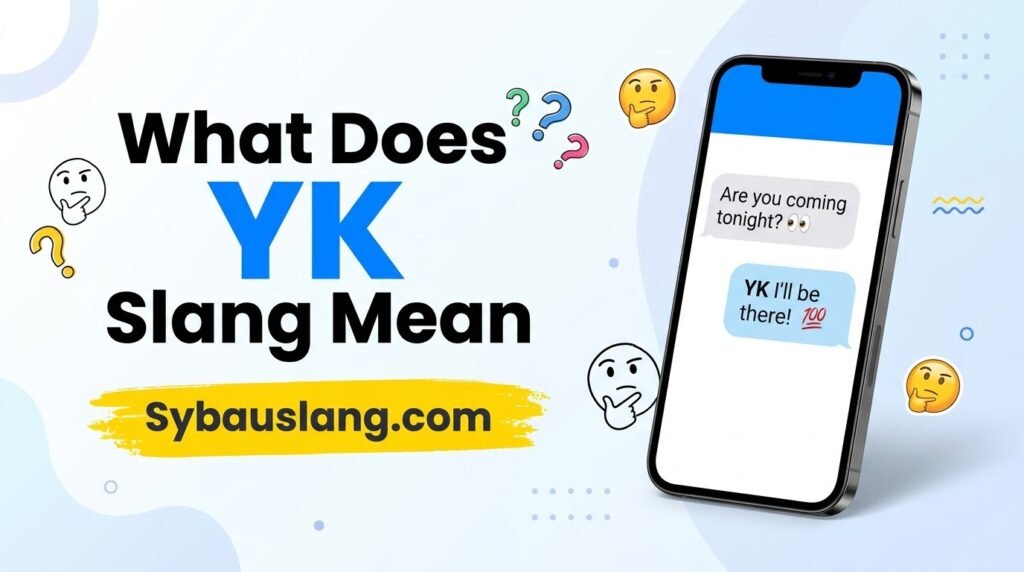
Say you tell a friend, “I just feel tired all the time, yk?” You are not asking whether they know you feel tired. You are saying, “Does this make sense to you?” or “I hope you understand.” The phrase softens the sentence and invites the other person in.
So when someone asks “what does yk slang mean,” the plain answer is “you know.” The more useful answer is that it works as a conversation helper. It can mean:
- “Do you understand?”
- “Right?”
- “You get it, don’t you?”
- “As we both know…”
- Nothing in particular, just a verbal pause in written form
The last one surprises people. A lot of the time yk is filler, the same way people say “like” or “um” out loud.
Where Does YK Come From?
The phrase “you know” is much older than texting. English speakers have used it as a conversational filler for a very long time, and linguists often group it with “I mean,” “well,” and “you see.”
These small words are sometimes called discourse markers. They don’t add facts to a sentence. They manage the flow of talking.
Abbreviating it came with fast typing. Early text messaging charged by the message and limited the number of characters, so people cut words down: “you” became “u,” “are” became “r,” “be right back” became “brb.”
Chat rooms, instant messengers and later social apps kept the habit alive, even after the limits stopped mattering. Shorter was simply faster, and it felt more casual.
YK is the same story. Typing “you know” takes eight keystrokes with the space, and “yk” takes two. When you are replying quickly on a phone, that adds up, and the clipped look also gives a message a relaxed, off-the-cuff feel.
I can’t point to one exact date or person who “invented” yk, and nobody really can, because abbreviations like this spread gradually through use. What we can say is that it grew out of ordinary speech habits and short-form typing culture.
Why Do People Use YK in Messages?
Understanding the reasons helps you read the tone correctly. Here are the main jobs yk does.
1. It Checks That the Other Person Understands
This is the most common use. When you are explaining something personal, vague or emotional, yk works like a gentle nudge.
“Work has been a lot lately, yk.”
You aren’t giving a full explanation. You are trusting the other person to fill in the gaps.
2. It Fills the Space Like a Spoken Pause
In real speech, people say “you know” while they think. Typing yk copies that rhythm, so messages sound less stiff.
“I was gonna go, but yk, I was kinda tired.”
Here it does almost nothing grammatically, but it makes the sentence sound like a person talking.
3. It Signals Shared Knowledge
Sometimes yk means “we both know what I’m talking about.” That works well with close friends who share context.
“He did the thing again, yk.”
If the reader knows who “he” is and what “the thing” is, the message is complete. If they don’t, they’ll be confused, which is why this use depends on closeness.
4. It Softens a Statement
Direct statements can feel blunt. Adding yk makes them gentler.
“I don’t really like that place, yk.”
The sentence is still an opinion, but it sounds less like a verdict.
5. It Adds Emphasis or Emotion
Depending on how it’s placed, yk can add feeling.
“I really miss them, yk.”
The yk here carries a small ache. Readers usually pick up on that.
6. It Starts or Continues a Casual Tone
Using yk early in a conversation tells the other person, “this is a relaxed chat.” It sets the register.
YK vs Similar Slang: What’s the Difference?
People often meet yk alongside several lookalikes. Here is how they differ.
YK vs YKWIM
YKWIM means “you know what I mean.” It is more direct. You use it when you’ve described something awkwardly and want confirmation.
“It was just a weird vibe, ykwim?”
YK is lighter and can be pure filler. YKWIM almost always asks for agreement.
YK vs YKYK
YKYK means “you know, you know.” It usually refers to something that only certain people understand, such as an inside joke or a niche community reference.
“That song at 2am, ykyk.”
If you don’t “know,” you’re meant to feel slightly outside the joke. It’s playful, not unkind. Compared with plain yk, ykyk is more about belonging and shared secrets.
YK vs YKW
YKW usually means “you know what.” People use it to introduce a thought.
“Ykw, forget it. Let’s just go.”
Don’t confuse it with ykwim. The two are close in spelling but different in meaning. Context normally makes it obvious: ykw sits at the start of a thought, and ykwim sits at the end.
YK vs YKNOW
Yknow is just a squashed version of “you know.” It appears in the same situations as yk. Some people prefer it because it looks a little more like how the phrase sounds when spoken quickly.
YK vs IK and IDK
- IK means “I know,” usually agreeing or acknowledging.
- IDK means “I don’t know.”
- YK means “you know.”
The pronoun changes who is “knowing.” These three show up together in chats all the time, so it helps to keep them apart.
YK vs “Y’know”
“Y’know” is the traditional written form of the spoken phrase, with an apostrophe. Yk is the modern shortened version. Meaning is identical.
YK Slang in Different Platforms
The same two letters can feel slightly different depending on where you see them.
Text Messages
On SMS and iMessage, yk is usually conversational filler between friends and family. It’s rare in formal or first-time messages.
Snapchat and Instagram DMs
Fast, casual replies are the norm here, so yk shows up constantly, often combined with other abbreviations like “tbh,” “rn” and “ngl.”
TikTok Comments and Captions
In comments, yk often points at a shared experience or trend. In captions, it can be a mood-setter: “late night drive, yk.”
Gaming Chats
Players type quickly during matches. Yk is often a throwaway word in a longer line like “he was right there yk.” It’s quick and rarely meant seriously.
Discord and Group Chats
Communities develop their own style, but yk generally appears as a relaxed filler. In tight friend groups, ykyk becomes the favorite since it signals the inside joke.
X (Twitter) and Threads
Posts there often copy spoken language. Yk can give a post a personal, half-confiding tone.
Real-Life Style Examples of YK in Sentences
Seeing yk in context is the quickest way to feel its meaning. Here are examples grouped by situation.
Checking Understanding
- “I’m just not in the mood to go out tonight, yk?”
- “It’s not that I’m mad, I’m just tired of explaining, yk.”
- “She’s really nice but kind of intense, yk.”
- “I want to help, but I also have my own stuff going on, yk.”
- “It’s hard to explain, but it just felt off, yk?”
Filler in the Middle of a Sentence
- “So I was walking home, yk, and it started raining.”
- “I told him, yk, that I’d be there by six.”
- “It’s kind of, yk, a long story.”
- “We could, yk, just order pizza instead.”
- “I didn’t want to say anything, yk, in front of everyone.”
Sharing Feelings
- “I miss how things used to be, yk.”
- “Some days I just want to stay home and do nothing, yk.”
- “I’m proud of you, yk. Like actually.”
- “I’m happy for them, I just feel a little left out, yk.”
- “Being the new kid is rough, yk.”
Casual Plans and Banter
- “Come over later if you’re free, yk, no pressure.”
- “Let’s get food after class, yk, the usual place.”
- “I’ll probably be late, yk how I am.”
- “We should do something this weekend, yk, just chill.”
- “You owe me a coffee, yk.”
Shared Context and Inside Jokes
- “Guess who texted me again, yk.”
- “Same old story with that teacher, yk.”
- “He did his usual thing at lunch, yk.”
- “The way we laughed at that meme for an hour, ykyk.”
- “That one night at the lake, ykyk.”
With “What” or “How”
- “Yk what? I’m doing it.”
- “Yk how it is.”
- “Yk what I mean when I say that?”
- “Yk why I’m upset, right?”
- “Yk who I saw today?”
In Captions and Comments
- “Golden hour hits different, yk.”
- “Just me and my coffee, yk.”
- “No plans, no stress, yk.”
- “This song though, ykyk.”
- “Quiet nights are underrated, yk.”
Standing Alone as a Reply
- A: “Today was exhausting.” B: “yk.”
- A: “Do you ever just feel stuck?” B: “yk, honestly.”
- A: “My brother ate my food again.” B: “Ugh, yk.”
In each of these, you can swap yk for “you know” and the sentence still works. That’s a quick test for whether you’re using it correctly.
How the Tone of YK Changes
Two letters can carry a lot of different feelings. Here’s how to read them.
Friendly and Warm
Most of the time, yk is friendly. It signals comfort and closeness. Someone who adds yk to a message is usually relaxed around you.
Vulnerable or Emotional
When paired with a sad or honest statement, yk sounds like a quiet request: “please understand me.” Responding with kindness works better than a joke here.
“I’ve been feeling lonely lately, yk.”
A good reply: “I get that. Want to talk about it?”
Flirty
With a crush, yk can add a little teasing or warmth.
“You’re kind of fun to talk to, yk.”
Notice it’s softer than a flat compliment. It leaves room to back out, which is part of the appeal in early flirting.
Annoyed or Sarcastic
Punctuation and context can flip the tone.
“Yeah, because that always works out, yk.”
Here yk comes with an eye-roll. A period, a sarcastic phrase, or a message that follows an argument all hint at this reading.
Passive-Aggressive
Occasionally it works as a hint without saying the complaint outright.
“I’d just appreciate it if people replied, yk.”
If you receive something like this, it may be worth asking directly what’s bothering them.
The key point is that yk rarely carries meaning alone. Read the words around it, and think about who sent it and how they usually write.
Is YK Slang Okay to Use at Work or School?
Short answer: usually not in formal situations.
Where It Fits
- Chats with coworkers you know well, in a casual team channel
- Quick messages with classmates
- Social media posts and comments
Where It Doesn’t Fit
- Emails to managers, clients or teachers
- Cover letters and job applications
- Reports, essays and official documents
- First messages to someone you’ve never spoken to
Why It Matters
Abbreviations can come across as careless in formal writing. Some readers also may not know them, which creates confusion. A clear sentence like “As you know, the deadline is Friday” reads better in professional settings than “deadline is Friday, yk.”
A good rule: if you’d wear pajamas to it, yk is fine. If you’d wear a suit, write the full words.
How to Reply When Someone Sends YK
Many people freeze when they get a “yk?” because it seems to demand a response. Here are simple options.
If You Understand
- “Yeah, I get it.”
- “Totally.”
- “Yep, makes sense.”
- “I feel that.”
If You’re Not Sure
- “Not totally, can you explain?”
- “Hmm, I’m not following. What happened?”
- “Wait, what do you mean?”
If They Shared Something Emotional
- “That sounds really hard.”
- “I’m here if you want to talk.”
- “Thanks for telling me.”
If It Was Just Filler
You can ignore the yk and respond to the main point. Nobody expects a special answer to filler.
If It’s a Joke or Inside Reference (YKYK)
- “Oh I know 😂”
- “Say less.”
- “Don’t remind me.”
If you honestly don’t know the reference, saying so is fine: “Okay I’m lost, fill me in.”
How to Use YK Slang Correctly: Step-by-Step
If you want to use it naturally, here’s a simple approach.
Step 1: Pick the Right Setting
Casual texts, social posts and friendly chats are safest.
Step 2: Decide What It’s Doing
Is it filler, a check for understanding, or a hint of shared knowledge? Knowing helps you place it well.
Step 3: Place It Where You’d Say It Out Loud
Read your sentence in your head. Where would you naturally say “you know”? That’s usually where yk belongs, typically at the end or after a comma in the middle.
Step 4: Add a Question Mark Only When You Mean It
“Yk?” asks for agreement. “Yk.” with a period feels more like a statement or a sigh.
Step 5: Don’t Overdo It
One yk per message is plenty. Stacking them can make you sound unsure or distracted.
Step 6: Match the Other Person
If your friend never uses abbreviations, you may want to ease off. If they use them constantly, yk will fit right in.
Common Mistakes People Make With YK Slang
Even a tiny abbreviation can trip people up. Here are the mistakes I see most often, with fixes.
Mistake 1: Mixing It Up With Other Abbreviations
People confuse yk, ykw, ykwim and ykyk. They aren’t interchangeable.
Fix: Remember that yk = “you know,” ykw = “you know what,” ykwim = “you know what I mean,” ykyk = “you know, you know.”
Mistake 2: Using It in Formal Writing
Dropping yk into an email to your boss or a school essay looks unprofessional.
Fix: Write the full phrase or rephrase the sentence entirely.
Mistake 3: Overusing It
A message like “I was, yk, thinking, yk, maybe we could, yk, go out” is tiring to read.
Fix: Use it once, or skip it when the sentence is already clear.
Mistake 4: Assuming Everyone Understands
Older relatives, new acquaintances, or people from different regions may not know it.
Fix: When in doubt, write “you know” or add a short explanation.
Mistake 5: Misreading the Tone
Taking a sarcastic yk as sincere, or a sincere yk as sarcastic, can cause awkward moments.
Fix: Look at the whole message and your history with the sender. If it’s unclear, ask.
Mistake 6: Using YKYK When the Audience Doesn’t Know
If you say “ykyk” about something nobody shares, it just confuses people or sounds like you’re showing off.
Fix: Save ykyk for people who really share the reference.
Mistake 7: Using It to Dodge Honesty
Sometimes people lean on “yk” instead of saying what they mean. “It’s complicated, yk” leaves the other person guessing.
Fix: If it’s an important topic, say the actual thing clearly.
Mistake 8: Ignoring Capitalization and Punctuation Cues
Writing “YK” in caps can come across as shouting or emphasis. Lowercase “yk” feels calmer.
Fix: Use lowercase for a relaxed tone and caps only when you want strong emphasis.
Practical Tips for Understanding and Using YK Slang
Here are some quick tips you can use right away.
- Translate it in your head. Replace yk with “you know” and read the sentence. Meaning usually clicks right away.
- Look at punctuation. A question mark invites agreement. A period often signals a sigh or an end of thought.
- Consider the relationship. Between close friends, yk means warmth. From a stranger, it might just be habit.
- Don’t overthink filler. If the sentence works without it, it was probably filler and you can reply to the main point.
- Ask when unsure. A quick “what do you mean?” is better than guessing wrong, especially about feelings.
- Keep it lowercase in casual chats. It looks natural and relaxed.
- Mix it sparingly with other slang. One or two abbreviations per message is readable. Ten is a puzzle.
- Use full words in important messages. Apologies, serious conversations and formal requests deserve clear, complete sentences.
- Teach it kindly. If a parent or grandparent asks what it means, a simple “it just means you know” is enough.
- Notice your own habits. If you type yk in every message, try cutting a few and see whether your writing improves.
YK Slang for Parents and Beginners
If you’re a parent reading your teen’s messages, or you’re new to texting culture, the good news is that yk is harmless. It’s one of the most innocent abbreviations out there. It carries no hidden or inappropriate meaning in normal use.
Here’s a short cheat sheet:
- yk = you know
- ykwim = you know what I mean
- ykyk = you know, you know
- ykw = you know what
- ik = I know
- idk = I don’t know
- tbh = to be honest
- rn = right now
- ngl = not gonna lie
When a message doesn’t make sense, the trick is to read it aloud in a casual voice. Most slang abbreviations are just spoken English typed quickly.
If you want to understand your teen better, you don’t need to copy their slang. Asking, “What does that mean?” with genuine curiosity usually works much better than guessing or trying too hard to sound cool.
Why Do Abbreviations Like YK Spread So Fast?
There are a few simple reasons.
Speed. Typing on a phone is slower than speaking, so shorter forms save effort.
Tone. Casual abbreviations make writing feel friendly instead of formal. A message with yk feels like a voice, not a document.
Belonging. Shared slang signals that you’re part of a group. Knowing what ykyk means is a small way of belonging.
Habit and repetition. Once enough people see a term, they start using it. Social media accelerates this by putting the same phrases in front of millions of readers.
Playfulness. Language is fun. People enjoy bending words, and short forms invite creativity.
None of this is new. Every generation has had its own shorthand, and older ones sometimes sounded just as confusing to their parents.
Is YK Slang Going Away?
It’s hard to predict, and anyone claiming certainty is guessing. Some slang fades within a year. Others, like “you know” itself, last for centuries. Because yk is rooted in a very old spoken habit rather than a trendy joke, it has a better chance of lasting than many viral terms. Expect it to stay a normal part of casual texting for the foreseeable future, even if specific phrases like ykyk rise and fall in popularity.
Frequently Searched Variations of “What Does YK Slang Mean”
People type many versions of this question into search engines. Here are the common ones, answered briefly:
- “What does yk mean in text?” It means “you know.”
- “What does yk stand for?” You know.
- “What does yk mean on Snapchat?” The same: “you know,” used casually in chats and captions.
- “What does yk mean from a girl / from a guy?” It means “you know” in both cases, usually as filler or to check understanding. The tone depends on the message, not on the sender’s gender.
- “What does ykyk mean?” “You know, you know,” referring to shared knowledge.
- “What does ykwim mean?” “You know what I mean.”
- “What does yk mean in gaming?” Typically “you know,” used as filler during fast typing.
- “What does yk mean in rap or songs?” Usually the same filler “you know,” sometimes written out in lyrics sites.
Frequently Asked Questions (FAQs)
What does YK slang mean?
YK is short for “you know.” People use it in casual texts and online posts as filler, to check that someone understands, or to refer to something both people already know about. It’s the written form of a very common spoken habit.
What does YK mean in a text message?
In a text, yk usually means “you know,” often at the end of a sentence like “I’m just tired, yk?” It softens what you’re saying and invites the other person to relate. In many cases it carries no extra meaning beyond sounding conversational.
Is YK the same as YKWIM?
Not quite. YK means “you know,” while YKWIM means “you know what I mean.” YKWIM is more direct and asks for understanding, while yk can be pure filler. Both are casual and harmless.
What does YKYK mean?
YKYK means “you know, you know.” It usually points to an inside joke or shared experience that only certain people understand. If you’re not part of the group, you may feel out of the loop, but it’s meant to be playful.
Is YK a rude word?
No. YK is not rude or offensive. It’s simply an abbreviation of “you know.” The only time it might sound rude is when it’s used sarcastically, which depends on the tone and context of the message rather than the abbreviation itself.
Can I use YK in a professional email?
It’s best to avoid it. Professional writing generally calls for full words and a polished tone. In very casual workplace chats with coworkers you know well, it may be fine, but in emails to clients, managers or teachers, write “you know” or rephrase the sentence.
How do I reply to someone who sends “yk?”
Respond to the feeling or point behind it. You can say “I get it,” “Totally,” or “Not sure I follow, what do you mean?” If they shared something emotional, a kind reply like “That sounds tough, I’m here” works better than a joke.
Should YK be capitalized?
Lowercase “yk” is the most common and gives a relaxed tone. Capital “YK” can feel like emphasis or shouting. Neither is wrong, but lowercase usually fits casual conversation better.
Where did YK slang come from?
It comes from the spoken filler phrase “you know,” which has been used in English for a long time. Texting and online chat encouraged shortening it to save time and keep a casual feel. There’s no single known inventor, since it spread gradually through everyday use.
Does YK have any hidden or inappropriate meaning?
In normal use, no. YK is a harmless abbreviation for “you know.” As with any slang, context matters, but there is no widely recognized hidden meaning behind it. If a message seems unusual, the surrounding words will clarify what the person means.
Conclusion
Now you know the answer to “what does yk slang mean”: it’s “you know,” a tiny shorthand that carries a lot of everyday conversation with it. Most of the time it’s filler, a way to make texting sound like talking.
Other times it checks that someone understands you, softens a statement, or hints at something you both already share.
The best way to read yk is to swap in “you know” and look at the tone around it. A question mark, a sad sentence, or a joking reference all change how it lands.
Related terms like ykwim, ykyk and ykw follow the same idea, with small differences worth remembering so you don’t mix them up.
If you want to use it yourself, keep it light. One yk in a casual message is plenty, and formal writing should skip it entirely. Pay attention to who you’re talking to, since not everyone knows the shorthand.
And if a message ever feels unclear or emotional, ask a real question instead of guessing.
Slang can look confusing from the outside, but yk is one of the friendliest examples. Once you spot it, you’ll realize you’ve been saying it out loud for years.