
Cooked slang meaning is simple once you see it in action: when someone says they’re “cooked,” they mean they’re in deep trouble, completely out of options, or too exhausted to keep going.
You’ll hear it in group chats, gaming streams, classrooms, and comment sections. Many people search for it after seeing a confusing reply like “bro, I’m so cooked” and wondering whether it’s good or bad.
It’s almost always bad, and usually said with a laugh. This guide covers the meaning, the origin, the different uses, plenty of examples, and the mistakes that make people sound out of touch.
Table of Contents
Quick Table: Cooked Slang at a Glance
| Topic | Meaning / Purpose | Best For | Style / Type | Useful Tip |
|---|---|---|---|---|
| “I’m cooked” | I’m in serious trouble or can’t recover | Texting friends, gaming, school humor | Casual, self-deprecating | Say it about small problems for comedy |
| “We’re cooked” | The whole group is in a bad spot | Group chats, team situations | Casual, shared humor | Works best when everyone understands the stakes |
| “He/She got cooked” | Someone was beaten, embarrassed, or outplayed | Sports, games, debates, roasts | Playful, sometimes harsh | Don’t use it to mock someone who is genuinely hurting |
| “This is cooked” | Something is broken or hopeless | Tech problems, plans, projects | Casual | Pair with the situation so the meaning is clear |
| “Cooked” (tired) | Completely exhausted | After exams, workouts, long shifts | Casual, mild | Common in Australia, the UK, and online |
| “Cooking” / “Let him cook” | Doing great, let them continue | Praise, hype | Positive slang | Do not confuse it with “cooked” |
What Does “Cooked” Mean in Slang?
In slang, “cooked” means doomed, finished, or in a hopeless situation. If you say “I’m cooked,” you’re saying something like “I’m done for,” “I’m in big trouble,” or “there’s no way out of this.”
That’s the short answer, and it covers most uses you’ll see online. The word borrows from real cooking. Once food is cooked, you can’t undo it. The same idea applies to the slang: whatever is going wrong has already gone too far to fix.
The tone is nearly always humorous. People rarely say “I’m cooked” in a truly tragic moment. They say it when they forgot about an assignment, bombed a game, spent too much money, or fell asleep before an alarm. It’s dramatic on purpose, and that exaggeration is part of the joke.
The One-Sentence Definition
Cooked (slang): in a bad situation with little or no chance of fixing it, or extremely tired and worn out.
Cooked Slang Meaning in Plain English
Here are some ways to translate it in everyday speech:
- “I’m cooked” = “I’m in trouble” or “I’m done for.”
- “We’re cooked” = “We’re all in trouble” or “We’re not going to make it.”
- “That team is cooked” = “That team has no chance.”
- “My phone is cooked” = “My phone is broken.”
- “My legs are cooked” = “My legs are completely worn out.”
- “You got cooked” = “You got beaten badly” or “You got embarrassed.”
Why People Search for the Cooked Slang Meaning
The word looks familiar, but the meaning isn’t what you’d guess. “Cooked” sounds like it should be about food, so people hearing it in a text or video get stuck. A few common situations send people to Google:
- A teenager says “I’m cooked for this exam,” and a parent isn’t sure whether to worry.
- A comment on a gaming clip says “he got cooked,” and the viewer can’t tell if it’s a compliment.
- A coworker jokes “we’re so cooked” about a deadline.
- Someone sees “let him cook” in one place and “he’s cooked” in another and assumes they mean the same thing.
The confusion is understandable, because the words are close but the meanings are almost opposite. We’ll untangle that below.
Where Did the Slang Term “Cooked” Come From?
Nobody can point to one exact moment when “cooked” became slang, and anyone who claims a single inventor is guessing. But we can trace the likely roots.
The Old Idiom: “Your Goose Is Cooked”
English has had the phrase “your goose is cooked” for a long time. It means you’re in serious trouble and there’s no saving the situation. Shortening that to “you’re cooked” is a natural step. Slang often works this way: a longer idiom gets trimmed to its most punchy word.
Gaming and Streaming Culture
Online games and live streams spread the term fast. Players used “cooked” when a match was clearly lost, a character was about to die, or a strategy had failed. Streamers often asked their audience things like “Chat, am I cooked?” when they were in a tight spot. Short, dramatic words fit fast-moving chat rooms well, and “cooked” is exactly that.
Social Media and Meme Culture
Short video apps and meme pages then carried the word to a much wider audience. A student showing a mountain of homework could caption it “I’m cooked.” A video of a failed prank could be labeled “he’s cooked.” The word was short, funny, and easy to attach to almost any bad situation, so it spread quickly.
Other Everyday Uses That Fed Into It
The word already had informal meanings in some places. In parts of the English-speaking world, people have long said they feel “cooked” when they’re worn out or overheated. The sports world has also used “cooked” for a defender who got beaten badly by an attacker. So the slang didn’t appear from nowhere. It gathered several existing meanings and became one flexible word.
The Different Meanings of “Cooked”
The core idea stays the same, but the flavor changes with context. Here are the main uses.
1. Cooked Meaning “In Big Trouble”
This is the most common use. Something bad is likely to happen, and the speaker feels powerless.
- “I haven’t started my essay and it’s due in two hours. I’m cooked.”
- “My mom just found out I skipped class. I’m so cooked.”
- “If the boss checks that report, we’re cooked.”
2. Cooked Meaning “Exhausted”
Sometimes “cooked” is about energy rather than trouble. You feel drained, wrung out, and unable to do more.
- “After that double shift, I’m completely cooked.”
- “That hike was brutal. My legs are cooked.”
- “I studied for six hours straight. My brain is cooked.”
You may also hear “fried” in this sense, as in “my brain is fried.” The two are close cousins.
3. Cooked Meaning “Beaten or Embarrassed”
When someone is outplayed, outsmarted, or roasted, they got cooked.
- “He tried to dribble past her and got cooked.”
- “That comeback in the debate? The other guy was cooked.”
- “Her roast was so good he was cooked.”
This use can be playful or a bit mean, depending on who says it and who it’s about.
4. Cooked Meaning “Broken or Ruined”
For objects, systems, and plans, “cooked” means broken beyond repair.
- “My laptop won’t turn on. It’s cooked.”
- “The group project is cooked. Nobody did their part.”
- “Our weekend plans are cooked because of the rain.”
5. Cooked Meaning “Hopeless Situation for a Group”
“We’re cooked” or “they’re cooked” describes a collective problem.
- “Three players are injured. The team is cooked.”
- “If the Wi-Fi goes out during the exam, we’re all cooked.”
- “Prices keep going up. We’re cooked.”
You’ll see this one a lot in comment sections, where people use it half-seriously about the economy, the job market, or their sports team.
6. The Older “Cooked” Meaning Intoxicated
In some circles, “cooked” has also been used to describe someone who is very drunk or high. This is a separate, older sense that is less common in Gen Z usage but still around. If the surrounding conversation is about parties or substances, that may be the intended meaning. Context will tell you.
7. The Literal Meaning
And of course, “cooked” can still just mean cooked. If you ask someone whether the chicken is cooked, they won’t answer “yes, we’re doomed.” Slang only works when the context supports it.
Cooked vs. Cooking vs. “Let Him Cook”
This is the part where most people get tripped up. The words share a root but point in opposite directions.
| Phrase | Meaning | Tone | Example |
|---|---|---|---|
| “I’m cooked” | I’m in trouble or finished | Negative, usually funny | “I forgot my homework. I’m cooked.” |
| “He’s cooking” | He’s doing really well right now | Positive | “He’s cooking in this game.” |
| “Let him cook” | Give him space, he’s doing something good | Positive or supportive | “Don’t interrupt, let him cook.” |
| “Cook” (as a noun) | A skilled performer, or a great output | Positive | “That song is a cook.” |
| “He got cooked” | He was beaten or embarrassed | Negative | “He got cooked in that argument.” |
| “Cooked” (about someone else’s work) | Hopeless or bad | Negative | “That plan is cooked.” |
A quick way to remember it: cooking is the process, and cooked is the finished result. If someone is still cooking, good things may be coming. If they’re cooked, the outcome is already decided, and it isn’t good.
One more twist. Sometimes you’ll see “cooked” used with admiration, as in “she cooked that performance.” Here “cooked” is the past tense of the verb “cook,” meaning she did it brilliantly. This usage is less common, and the grammar gives it away. “She cooked” (an action) is praise. “She is cooked” or “she got cooked” (a state or something that happened to her) is bad news.
How to Use “Cooked” in a Sentence: Real-Life Examples
Examples make slang easier to understand than any definition. Here are plenty, sorted by situation.
Cooked in School and Studying
- “The exam is tomorrow and I haven’t opened the textbook. I’m cooked.”
- “The teacher said the quiz is on chapters 4 to 8. I only read chapter 4. Cooked.”
- “If she asks for the homework, I’m cooked.”
- “Our group presentation starts in ten minutes and half the slides are blank. We’re cooked.”
- “He copied the wrong answers and the teacher noticed. He’s cooked.”
- “I accidentally submitted the wrong file. Am I cooked?”
- “After finals week, my whole brain is cooked.”
- “The professor said no extensions. We’re all cooked.”
Cooked at Work
- “The client moved the deadline up by a week. We’re cooked.”
- “I sent the email to the wrong person. I’m cooked.”
- “If the server crashes during the demo, we’re cooked.”
- “Three people quit in one month. This department is cooked.”
- “My manager asked for the report I forgot to write. I’m cooked.”
- “After back-to-back meetings all day, I’m cooked.”
Cooked in Gaming
- “I have one health point left and three enemies nearby. I’m cooked.”
- “Our team lost the best player in the first minute. We’re cooked.”
- “That boss has a second phase? We’re cooked.”
- “He walked right into the trap. Cooked.”
- “My controller broke mid-match. Cooked.”
- “Chat, am I cooked?”
- “The other team has better gear, better aim, and better teamwork. We’re cooked.”
Cooked in Sports
- “The defender got cooked by that move.”
- “They’re down by twenty points with two minutes left. They’re cooked.”
- “The goalkeeper was cooked on that shot.”
- “Our star player just got injured. Season’s cooked.”
- “He’s been cooked all game by the other team’s fastest runner.”
- “Their legs were cooked by the fourth quarter.”
Cooked With Friends and Group Chats
- “You really told mom that? You’re cooked.”
- “Bro texted his ex at 2 a.m. He’s cooked.”
- “Did you see her reply? You are so cooked.”
- “We missed the last train home. We’re cooked.”
- “I just realized I left my wallet at the restaurant. Cooked.”
- “She read the message and didn’t reply. Am I cooked?”
Cooked With Technology
- “My phone fell in water. It’s cooked.”
- “The laptop screen has lines all over it. It’s cooked.”
- “The Wi-Fi is down, the hotspot is empty, and the deadline is in an hour. Cooked.”
- “My hard drive made a weird noise and now it won’t start. Cooked.”
- “I forgot to save the file and the app crashed. I’m cooked.”
Cooked in Dating and Relationships
- “I called her by the wrong name. I’m cooked.”
- “He forgot the anniversary. He’s so cooked.”
- “She found the old messages. We’re cooked.”
- “I told a joke that landed badly on the first date. Cooked.”
- “My crush saw me trip in front of everyone. Totally cooked.”
Cooked After Exercise or Hard Work
- “That leg day left me cooked.”
- “I ran way too fast at the start. I’m cooked by mile three.”
- “After carrying boxes all day, my back is cooked.”
- “The heat today cooked everyone at the outdoor event.”
Cooked in Everyday Lif
Cooked Slang in Texting and Social Media
Since most people first meet this word online, it helps to know how it looks in messages and posts.
Common Replies
- “Bro you’re cooked 😭”
- “Nah we’re so cooked”
- “He’s cooked fr”
- “Cooked cooked cooked”
- “Absolutely cooked”
- “You’re not cooked, you can still fix it”
- “Not me being cooked rn”
The crying-laughing emoji often shows up beside it, which tells you the speaker finds it funny, not tragic.
Common Caption Styles
People use “cooked” to caption photos and videos that show something going wrong or being overwhelming:
- A picture of a messy desk before a deadline: “Cooked.”
- A video of a missed catch: “He’s cooked.”
- A screenshot of a low bank balance: “We’re cooked.”
- A sunburned selfie: “Literally cooked.”
Reply Tone Tips
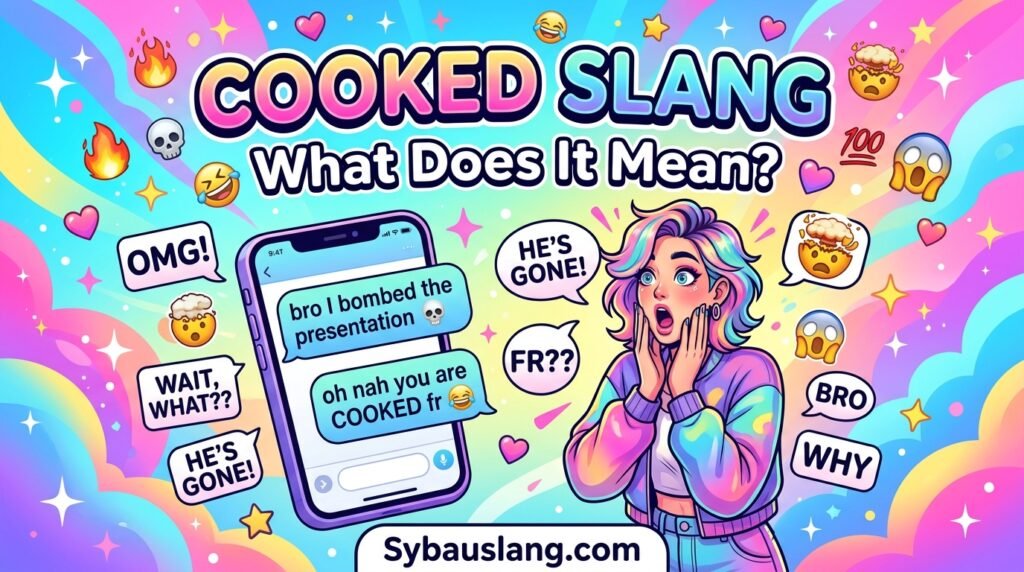
If a friend texts “I’m cooked,” read the tone before replying. Often they want a joke or a bit of sympathy, not a detailed solution. A reply like “lol what happened?” works better than a lecture. If the message sounds more serious or distressed, check in with them properly.
Cooked vs. Similar Slang Words
“Cooked” isn’t the only word that means “in trouble.” Here’s how it compares with other phrases.
| Word / Phrase | Meaning | How It Differs From “Cooked” |
|---|---|---|
| Toast | Finished, doomed | Very close in meaning; “toast” feels slightly older |
| Fried | Exhausted or mentally drained | More about tiredness; “my brain is fried” |
| Done for | Finished, no chance | More neutral, less meme-like |
| Screwed | In bad trouble | Stronger and a bit ruder |
| Dead / “I’m dead” | Either hopeless or laughing hard | Can mean laughter, not just trouble |
| Goner | Someone who is doomed | Usually describes a person, not a situation |
| Finished | Over, done | Can be neutral or negative |
| Washed | Past one’s prime or no longer good | About ability, not situation |
| Locked in | Focused and determined | The opposite energy |
“Cooked” works for people, objects, plans, and teams. “Washed” mostly works for people whose skills have faded, so don’t swap them. Saying “my phone is washed” would sound odd, while “my phone is cooked” sounds right.
Is “Cooked” Rude or Offensive?
Mostly, no. It is informal slang, not a swear word, so it won’t get you in trouble in most settings. Still, a few points are worth knowing.
Where It Works
- Texting friends and family
- Casual chats at school or college
- Gaming and streaming communities
- Social media comments and captions
- Friendly workplace jokes among close teammates
Where to Be Careful
- Formal emails and reports. Writing “the project is cooked” in a client email would look unprofessional.
- Job interviews. Stick to standard language.
- Serious or sensitive moments. If someone is facing a real loss or crisis, calling them “cooked” can sound dismissive.
- Mocking others. “You got cooked” is fine as a playful tease between friends, but it can hurt when aimed at someone who is already embarrassed.
The rule of thumb is simple: if you’d joke about it, “cooked” fits. If you’d handle it carefully, choose gentler words.
How to Use “Cooked” Correctly: Step by Step
If you want to use the word naturally, here’s a simple method.
Step 1: Pick the Right Situation
Use it when something has gone wrong or is about to, and you want to express that with humor. Missed deadlines, forgotten items, bad luck, and heavy workloads are all good fits.
Step 2: Choose Your Form
- Talking about yourself: “I’m cooked.”
- Talking about a group: “We’re cooked.”
- Talking about someone else: “He’s cooked” or “They’re cooked.”
- Talking about an object: “It’s cooked.”
- Talking about something that happened to someone: “He got cooked.”
Step 3: Keep the Tone Light
The word does best with a casual, half-joking delivery. Say it too seriously, and it can sound forced.
Step 4: Add Context When Needed
If the situation isn’t obvious, add a few words. “I forgot the presentation. I’m cooked” is clearer than just “I’m cooked.”
Step 5: Match Your Audience
Use it with friends, classmates, and online communities. With older relatives or formal contacts, you may need to explain it or use another phrase.
Common Mistakes People Make With “Cooked”
Slang is easy to get wrong, especially when you pick it up secondhand. These are the mistakes that come up most.
Mistake 1: Confusing “Cooked” With “Cooking”
This is the biggest one. “He’s cooking” is praise, and “he’s cooked” is bad news. A parent who tells a child “you’re cooking!” is complimenting them, not warning them. Swap the words and the whole message flips.
How to avoid it: Remember that “-ing” means it’s happening now and going well, while “-ed” means it’s already done, and not in a good way.
Mistake 2: Using It for Tiny, Meaningless Problems Constantly
Saying “I’m cooked” about every small thing makes the word lose its punch. If you’re cooked because you spilled a drop of water, the joke wears thin.
How to avoid it: Save it for moments with at least a little drama or humor.
Mistake 3: Using It in Formal Writing
Slang in a business report, cover letter, or school essay can hurt your credibility.
How to avoid it: Use “in serious trouble,” “unlikely to succeed,” or “unrecoverable” in formal contexts.
Mistake 4: Applying It to a Serious Tragedy
Joking that a grieving person or someone with a health crisis is “cooked” is insensitive.
How to avoid it: Read the room. If the situation involves real pain, skip the slang.
Mistake 5: Thinking It Always Means Trouble
Sometimes “cooked” refers to being tired, beaten in a game, or a broken object. If you only know one meaning, you may misread a message.
How to avoid it: Look at the context. Is it about a game, a workout, a device, or a plan? That tells you which meaning applies.
Mistake 6: Trying Too Hard
Adults and brands sometimes drop slang into their writing to seem young, and it can come off as awkward. A teacher who says “we’re all cooked, y’all” might get eye rolls.
How to avoid it: Use slang only when it feels natural to you. If you’d never say it out loud, don’t force it.
Mistake 7: Assuming Every Region Uses It the Same Way
Slang shifts between countries and communities. In some places “cooked” leans toward “tired” or “drunk,” while online it leans toward “doomed.”
How to avoid it: If you’re unsure, ask or check how others around you use it.
Practical Tips for Understanding and Using “Cooked”
These are quick, usable ideas you can start applying right away.
- Read the surrounding message. The words before and after “cooked” nearly always reveal the meaning.
- Look for emoji clues. A laughing or crying-laughing emoji signals a joke, not a disaster.
- Check who’s talking. Slang usage differs between teens, gamers, athletes, and older speakers.
- Use it for yourself first. Saying “I’m cooked” about your own situation is safer than saying someone else is.
- Don’t overuse it. One well-placed “cooked” is funnier than five in a row.
- Learn the pair. Remember “cooked” (bad) and “cooking” (good) together so you never mix them up.
- Keep a plain-English backup. If someone older doesn’t get it, say “I’m in big trouble” or “I’m exhausted.”
- Match the tone of the chat. If everyone is joking, a joke fits. If someone is upset, respond kindly.
- Don’t put it in formal documents. Save it for casual spaces.
- Notice how it evolves. Slang changes quickly. What is popular today may sound dated in a year or two.
Practical Advice for Parents, Teachers, and Non-Slang Speakers
If you’re an adult trying to understand what young people are saying, you don’t need to start using the word yourself. Understanding it is enough.
For parents. When your child says “I’m cooked,” they usually mean “I’m stressed about something.” It’s a good opening to ask what’s going on. Respond with curiosity instead of alarm. Often the problem is small, like a forgotten assignment, and the dramatic wording is just how they talk.
For teachers. Students may say “we’re cooked” before tests, projects, and deadlines. It’s often a way of sharing nerves with classmates. It doesn’t mean they’ve given up, though it can be a hint that the workload feels heavy.
For employers and managers. If a younger employee says “we’re cooked” about a deadline, they’re flagging a real concern in casual language. Ask what’s behind the worry instead of correcting the vocabulary.
For writers and marketers. If you use the word in content, keep it natural and match the platform. Avoid forcing slang into brand messaging where it doesn’t fit.
Frequently Searched Variations of “Cooked Slang Meaning”
People search for this word in many forms. Here are the most common ones, answered briefly.
“I’m Cooked” Meaning
It means “I’m in serious trouble,” “I’m doomed,” or “I’m too tired to continue.” It’s usually said with humor.
“We’re Cooked” Meaning
It means a group of people is in a bad situation. A team, class, family, or friend circle can all be “cooked.”
“He’s Cooked” or “She’s Cooked” Meaning
This says someone is in trouble or has been beaten. In games, it can mean the player has no chance of winning.
“Cooked” Meaning in Gaming
In gaming, “cooked” means you or your team are about to lose, or you were defeated in a way that felt hopeless. Streamers often ask “Chat, am I cooked?” when a situation looks bad.
“Cooked” Meaning in Texting
In texts, it signals that someone is dealing with trouble, stress, or tiredness. The tone is usually lighthearted.
“Cooked” Meaning in Sports
In sports, a player who “got cooked” was beaten badly by an opponent. A team that is “cooked” is unlikely to win.
“Cooked” Meaning Gen Z
Among Gen Z speakers, “cooked” is a flexible word for being doomed, exhausted, or embarrassed. It’s one of several words that make bad situations sound funny.
“Cooked” Meaning Australian or British Slang
In some English-speaking regions, “cooked” has also eant tired or overheated, and sometimes intoxicated. The exact flavor depends on the speaker.
“Cooked” vs. “Fried” Meaning
Both can describe exhaustion. “Cooked” can also mean doomed or beaten, while “fried” leans more toward mental burnout.
“Am I Cooked?” Meaning
This is a half-joking way of asking “Is my situation as bad as I think?” or “Do I have any chance here?” People ask it about exams, relationships, games, and job interviews.
Mini Scenarios: Seeing “Cooked” in Context
Here are a few short stories to show how the word behaves in real conversations.
Scenario 1: The Forgotten Assignment
Maya texts her friend: “Bro, the essay is due at 9 and I haven’t started. I’m cooked.”
Her friend replies: “lol you’re not cooked, you’ve written faster before. Open the doc.”
Here “cooked” means in trouble, and the reply shows the word is often a joke that invites encouragement.
Scenario 2: The Online Match
A streamer is down to one life while three opponents surround him. He says, “Chat, am I cooked?” The chat floods with “yes,” “so cooked,” and “RIP.” It’s playful, and everyone, including the streamer, is laughing.
Scenario 3: The Basketball Game
Commentator: “He drives left, crosses over, and the defender is absolutely cooked.”
Meaning: the defender was beaten so completely that he had no chance.
Scenario 4: The Long Day
Sam arrives home after a twelve-hour shift and tells his roommate, “I’m cooked. Don’t talk to me for an hour.”
Here “cooked” means exhausted, not in trouble.
Scenario 5: The Mixed-Up Phrase
A father hears his son’s friend say “let him cook” and then, a minute later, “he’s cooked.” Confused, he asks what’s going on. The son explains: “Let him cook means he’s doing something great, so don’t interrupt. He’s cooked means he’s in trouble.” Same root, opposite energy.
Why Slang Like “Cooked” Catches On
Slang spreads when it does three things well: it’s short, it’s emotional, and it’s easy to reuse. “Cooked” does all three. It takes one syllable to say a lot, it carries a sense of drama, and it fits dozens of situations.
It also helps people laugh at stress. Calling an overwhelming week “cooked” makes it feel a little lighter. That’s a big reason the word spread through students, gamers, and workers. When a situation feels out of your hands, a funny word can take some pressure off.
Slang also builds belonging. Using the same words as your friends signals that you’re part of the group. That doesn’t make it silly. It’s how language has always worked, from old rhyming slang to modern internet phrases.
Will “Cooked” Last?
Nobody can predict the future of slang. Some words stay for decades, while others fade after a single summer. “Cooked” has an advantage because it’s rooted in an older idiom, “your goose is cooked,” and because the word is flexible. Terms like that tend to last longer than ones tied to a single meme or event.
Even so, expect its popularity to rise and fall. If it starts sounding dated to younger speakers, new words will take its place. For now, it remains a common way to describe a rough situation with a smile.
Quick Reference: How to Respond When Someone Says “I’m Cooked”
If a friend or family member uses the word, here are some natural replies.
When it’s a joke:
- “Lol, what did you do?”
- “Nah, you’ll figure it out.”
- “We’re all cooked together.”
When they seem stressed:
- “That sounds rough. Want help?”
- “What’s the worst that could happen?”
- “Let’s look at it step by step.”
When they’re exhausted:
- “Go rest. You’ve earned it.”
- “Want me to grab you something to eat?”
When it’s about a game or sport:
- “Respawn and try again.”
- “Next round, you’ve got this.”
The best reply depends on whether they want comfort, humor, or a plan. When in doubt, ask.
Frequently Asked Questions About Cooked Slang Meaning
What does “cooked” mean in slang?
“Cooked” means doomed, finished, or in a hopeless situation. It can also mean extremely tired. If someone says “I’m cooked,” they usually mean they’re in serious trouble or have run out of energy. The tone is typically humorous and exaggerated, not truly tragic.
What does “I’m cooked” mean in texting?
In texting, “I’m cooked” means “I’m in big trouble” or “I can’t handle this.” It’s often attached to deadlines, mistakes, or stressful moments. A laughing emoji usually shows the person is joking. If there’s no humor and the message sounds upset, check in with them kindly.
Is “cooked” a good or bad thing?
It’s almost always bad. “Cooked” describes failure, trouble, or exhaustion. The only time it’s positive is when “cooked” is the past tense of a verb, as in “she cooked that performance,” meaning she did it extremely well. Related phrases like “he’s cooking” and “let him cook” are positive, but “he’s cooked” is not.
4. What is the difference between “cooked” and “cooking”?
“Cooked” means finished or doomed. “Cooking” means someone is doing great right now. For example, “he’s cooking” praises a player who is performing well, while “he’s cooked” says he’s out of options. Think of cooking as the process and cooked as the final result.
What does “we’re cooked” mean?
“We’re cooked” means a group is in trouble. It can describe a class facing a hard test, a team about to lose, or friends who missed the last bus. People usually say it with a laugh, treating the problem as unavoidable but also a little funny.
Where did the slang “cooked” come from?
The exact origin isn’t clear, but it likely grew from the old idiom “your goose is cooked,” which means you’re in deep trouble. Gaming, streaming, and short video culture then helped popularize the shorter form. It also overlaps with older uses meaning tired or beaten.
What does “got cooked” mean?
“Got cooked” means someone was beaten, outplayed, or embarrassed. You hear it in sports, games, arguments, and roasts. For example, a defender who is easily dribbled past “got cooked.” It can be playful between friends but unkind if aimed at someone who is already upset.
Is “cooked” the same as “fried”?
They’re similar but not identical. Both can describe being worn out. “Fried” usually refers to mental exhaustion, such as a “fried brain” after studying. “Cooked” is broader and can mean doomed, beaten, broken, or tired. Use whichever fits the situation better.
Can I use “cooked” in a formal setting?
It’s best not to. “Cooked” is informal slang and may seem unprofessional in emails, reports, or interviews. For formal situations, use clearer phrases like “in serious trouble,” “unlikely to succeed,” or “completely exhausted.” Save the slang for friends, casual chats, and online spaces.
How do I know which meaning of “cooked” someone is using?
Look at the context. If the conversation is about deadlines or mistakes, it means trouble. If it’s about a workout or long day, it likely means tired. If it’s about a game or match, it means someone was beaten. If it’s about a device, it means broken. When you’re still unsure, simply ask.
Conclusion
Cooked slang meaning comes down to one idea: things have gone so wrong that there’s no easy way back, and the best response is often to laugh about it.
You now know that “I’m cooked” can mean trouble or exhaustion, that “he got cooked” means someone was beaten, and that “cooking” and “let him cook” point in the opposite direction.
The most useful habit is reading the context. A deadline, a game, a workout, a broken phone, and a team on a losing streak all give “cooked” a slightly different flavor, but the heart of it stays the same.
Keep the tone light, match your audience, and avoid it in formal writing or in moments when someone is truly hurting.
If you hear the word from a friend, child, student, or coworker, you can now respond with confidence. Ask what happened, offer a joke or some help, and remember that most people saying “I’m cooked” are just letting off steam.
Try using it yourself the next time a small disaster strikes. A little humor can make a bad day feel a lot more manageable.