
What Does 67 Mean in Slang? If you’ve seen “67” popping up in texts, TikTok comments, Instagram posts, or casual chats, you might wonder what people actually mean by it.
Slang numbers can be confusing because their meaning often depends on the conversation and the people using them.
“67” may be used as an inside joke, shorthand, reference, or trend rather than having one universal definition.
In this article, we’ll look at the possible meanings of 67, where you may encounter it, and how context can change its interpretation.
Before replying to someone, always check the surrounding conversation to understand what they intended.
Table of Contents
Quick Table
| Term | Meaning | Common Use | Context |
|---|---|---|---|
| 67 Slang | Varies by context | Texting & social media | Depends on the conversation |
| 67 Meaning | May be shorthand or a trend | Online chats | Informal |
| “67” | A number used as slang | TikTok, Instagram, texting | Context matters |
| 67 in Texting | Can have different interpretations | Messages & comments | Check surrounding words |
| 67 Online | Often used as an internet reference | Social media | May be community-specific |
My Nephew Kept Yelling “Six Seven” at Dinner, So I Went Down the Rabbit Hole
It started at a family dinner a few months back. My 11-year-old nephew asked for the salt, and when I asked how many spoons of rice he wanted, he said “six seven,” held both palms up, and wobbled his hands like he was weighing two invisible watermelons.
Nobody at the table reacted except the other kids, who lost it.
I asked what it meant. He said, “It doesn’t mean anything.” Then he laughed until he had to leave the room.
That answer bugged me more than any explanation would have. I write about tech and apps for a living, and I’d just been out-slanged by a sixth grader.
So I spent a couple of weeks figuring out where “67” came from, why kids won’t stop saying it, and what a parent, teacher, or older sibling can actually do with that information.
Here’s everything I learned, including a few things I got wrong along the way.
So what does “67” actually mean?
Honestly, close to nothing, and that’s the point.
Ask ten kids and you’ll get ten answers. Some say it means “so-so” or “maybe.” Some say it’s just a fun thing to shout. Most of them, like my nephew, say it doesn’t mean anything.
The confusion has a simple explanation. “67” is mostly a meme that grew out of other things:
- A song. The trail leads back to a 2024 drill track by the rapper Skrilla, with a “6-7” line in it. It spread on TikTok.
- Basketball. Basketball fans linked the number to the NBA player LaMelo Ball, who is listed at 6’7″. Edit videos of players and highlights piled up under the sound.
- A viral kid. A clip from a youth basketball game showed a kid enthusiastically yelling the phrase, and it took off from there.
- The hand motion. Palms up, alternately raised and lowered. It’s usually done while saying the number.
Once enough kids used it, the meaning stopped mattering. It became a shared joke that adults don’t get, which is exactly what makes slang stick.
The word-reference site Dictionary.com even picked “67” as its 2025 word of the year, which tells you how far it spread.
My first mistake: trying to “get it”
I spent an embarrassing amount of time trying to find the deeper meaning. I read forum threads, watched explainer videos, and even asked a couple of other parents.
That was a waste of time. The lesson I took away is that this kind of slang works because it’s absurd. If you find a logical explanation, you’ve probably missed the joke.
The second mistake was worse. I tried to use it myself.
At the next family gathering, I said “six seven” with the hand wobble, feeling clever. My nephew stared at me with the pity you’d give a dog wearing sunglasses. My niece said, “Please never do that again.”
If you’re an adult, you don’t need to speak fluent 67. You just need to know what it is so you’re not confused or, worse, quietly annoyed.

Why this matters more for parents and teachers than you’d think
At home, “67” is harmless. It’s a running gag.
At school, it’s a different story. I talked to a friend who teaches middle school, and she described it as the “new dab” (meaning it’s everywhere and gets on everyone’s nerves).
Kids drop it mid-lesson, everyone giggles, and class momentum dies. Some schools have reportedly asked students not to say it in class.
That’s a reasonable house rule if it’s disrupting learning, but it’s a school-by-school decision, so check what yours says.
Because the meaning is fluid, the only real problem is timing. The meme itself is harmless, but the number can get attached to something else, like a joke that isn’t. If you hear a kid using it in a way that seems off, ask what they mean instead of guessing.
How to actually see what your kid is watching (step by step)
This is the part where being a tech person came in handy. If you want to know where your child is picking up trends like this, here’s what worked for me.
Step 1: Look at the platform, not just the phone.
Most of this content lives on TikTok, YouTube Shorts, and Instagram Reels. Ask your kid which one they use most. Don’t demand to see the phone at first, just ask.
Step 2: Turn on the built-in family tools.
- On TikTok, use Family Pairing (Settings → Family Pairing). It lets you link your account to your child’s and set screen time limits and content restrictions.
- On YouTube, set up a supervised account through Google Family Link. You can choose content levels that fit their age.
- On iPhones, use Screen Time (Settings → Screen Time) to see which apps get the most use and set downtime.
Step 3: Search the trend yourself.
Open TikTok on your own account and search “67.” Watch five or six videos. You’ll see the pattern in about two minutes, and it’ll take a lot of the mystery (and worry) out of it.
Step 4: Talk about it like a normal person.
I made the mistake of opening with “Why do you keep saying that?” It sounded like an interrogation. What worked better was “Show me the six-seven thing.” He was thrilled to teach me, and that opened the door to a wider conversation about what else he watches.
Step 5: Set boundaries around behavior, not the words.
The number itself isn’t the issue. What matters is when and where. “No shouting it during homework” or “not at the dinner table” works better than a blanket ban, and kids actually follow it.
A quick reality check on privacy and safety
While I was poking around, I noticed something a lot of parents miss. Trending sounds and challenges are also where scammers and strangers show up in the comments. A harmless meme video can have a comment section that isn’t harmless at all.
A few habits I’d suggest:
- Keep your child’s accounts private.
- Turn off or limit comments from strangers.
- Teach them not to click links in comments or DMs, even if it says “free skins” or “V-Bucks.”
- If a video pushes them to join a group chat, check it out first.
None of this is specific to “67,” but trends are how strangers get in front of kids, so they’re a good moment to review your settings.
What I’d tell my past self
Looking back, most of my stress was wasted. Here’s the short version of what I learned:
- Slang rarely needs decoding. If it feels meaningless, that’s often the whole design.
- Don’t try to use it. It never lands and it ends the trend for them (they’ll move on to something else the moment adults adopt it).
- Use it as a way in. A silly meme is a much easier opening than “so what are you doing online?”
- Check the platform settings once. Ten minutes on Family Pairing or Family Link does more than weeks of nagging.
- Expect it to fade. Every meme has a shelf life. By next year, “67” will probably sound as dated as “on fleek.”
What if you’re a teacher?
A few ideas that worked for friends of mine:
- Acknowledge it once, then move on. Making it a big deal gives it power.
- Give it a moment. Some teachers let students do it once at the start of class, laugh, and get it out of their system.
- Set a simple rule. “Not during instruction” is easier to enforce than a total ban.
- Turn it into something useful. One teacher had students find a real-world use of the numbers 6 and 7 in their math lesson. It got a groan, but they remembered the lesson.
Where this leaves me
A few weeks later, my nephew and I have a deal. He can say “six seven” whenever he wants except at the table when we’re eating, and I promised never to do the hand thing again.
The funny part is that it wasn’t really about the number. I learned more about how he spends his time online in one conversation about a meaningless meme than I had in months of asking directly.
So if a kid in your life is suddenly shouting numbers and wobbling their hands, don’t panic and don’t overthink it. Ask them to show you. It’ll make them feel smart, and you’ll probably learn something.
And whatever you do, don’t try it yourself. Trust me on that one.
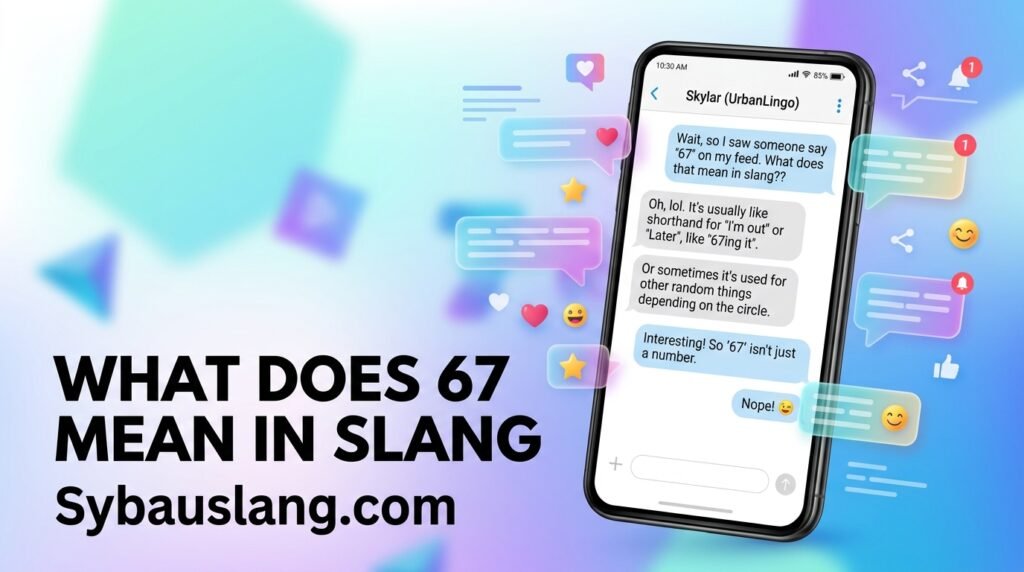
FAQ’s
What does 67 mean in slang?
The meaning of 67 in slang can vary depending on the context, platform, and community using it. It may represent a trend, inside reference, shorthand, or another meaning.
What does 67 mean in texting?
In texting, “67” does not have one universal meaning. The surrounding conversation usually helps determine what the sender intended.
Is 67 a TikTok slang term?
“67” may appear in TikTok comments or videos as part of an online trend or community-specific expression. Its meaning can change over time.
Can 67 have different meanings?
Yes. Numbers used as slang can have different meanings among different groups. Always consider the conversation and platform before interpreting it.
How can I understand 67 when someone sends it?
Look at the message before and after “67” and consider the topic being discussed. If it is still unclear, simply ask the person what they mean.
Conclusion
Understanding What Does 67 Mean in Slang is not always straightforward because number-based slang can depend heavily on context.
People may use “67” as part of an online trend, inside joke, shorthand, or community-specific expression. This means there may not be one meaning that applies to every conversation.
If you come across “67” on TikTok, Instagram, Snapchat, gaming platforms, or in a private text, pay attention to the surrounding words and the person using it. The same number can be understood differently in separate online communities.
Slang also changes quickly.
A term that becomes popular on social media can develop a new meaning or become less common over time. That is why checking current usage and considering the original context can help prevent misunderstandings.
Ultimately, the best way to understand 67 slang meaning is to avoid interpreting the number by itself. Look at the full message, consider the platform and conversation, and ask for clarification when necessary.
Whether you saw 67 in a comment, caption, text, or chat, context is the most important clue to understanding what the person actually intended.