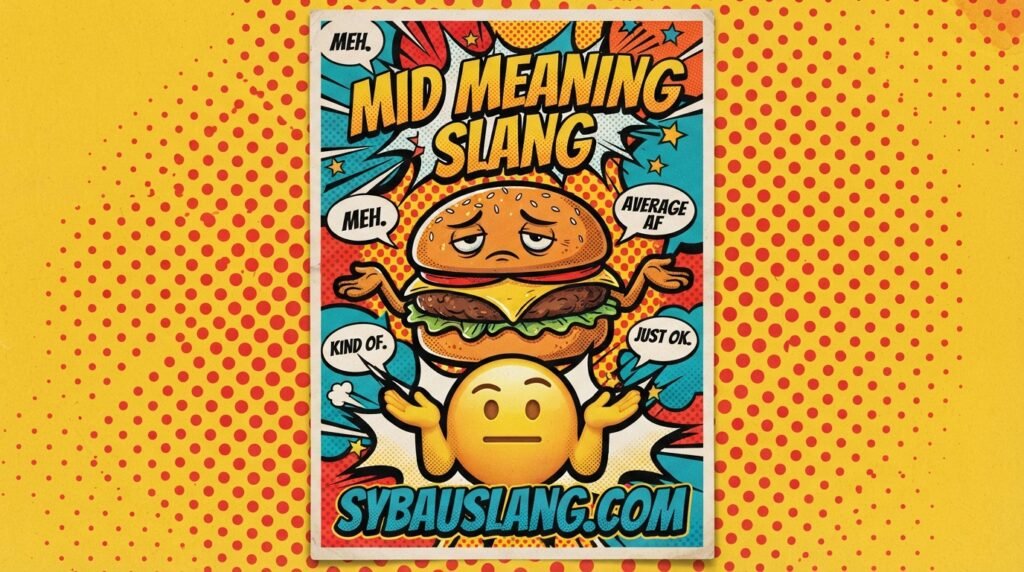
mid meaning slang refers to something that is considered average, ordinary, or not very impressive.
When someone calls a movie, song, food, outfit, or experience “mid,” they usually mean it is just okay and does not live up to the hype.
The term is commonly used in casual conversations, texting, TikTok comments, and other social media platforms.
For example, someone might say, “That new song is mid,” meaning they think the song is neither terrible nor amazing.
The word can sometimes sound dismissive or slightly insulting, depending on the context. Overall, “mid” is a quick way to describe something as mediocre or overhyped.
Table of Contents
Quick Table
| Term | Meaning |
|---|---|
| Mid | Average, mediocre, or not impressive |
| Mid meaning slang | Used to describe something as just okay |
| Tone | Casual, dismissive, or mildly negative |
| Commonly used on | TikTok, Instagram, Snapchat, X, and texting |
| Example | “That movie was mid.” |
| Similar words | Average, mediocre, ordinary, okay |
| Opposite | Fire, amazing, excellent, top-tier |
What Does “Mid” Actually Mean in Slang?
So here’s what happened. My cousin was over at my place, I made him a plate of biryani I’d been slow-cooking for like three hours, genuinely proud of it, and he takes one bite, shrugs, and says “eh, it’s mid.
“What Does “Mid” Actually Mean in Slang?
I laughed because I thought he meant medium spicy. He did not mean medium spicy.
Turns out “mid” had quietly become one of the most-used slang words among teenagers and young adults, and I was completely out of the loop.
If you’ve seen this word pop up in comments, texts, or TikTok captions and felt a little lost, you’re exactly who I’m writing this for.
So What Does “Mid” Actually Mean?
In slang terms, “mid” basically means average, mediocre, or just… okay. Not bad enough to hate, not good enough to praise. Just there.
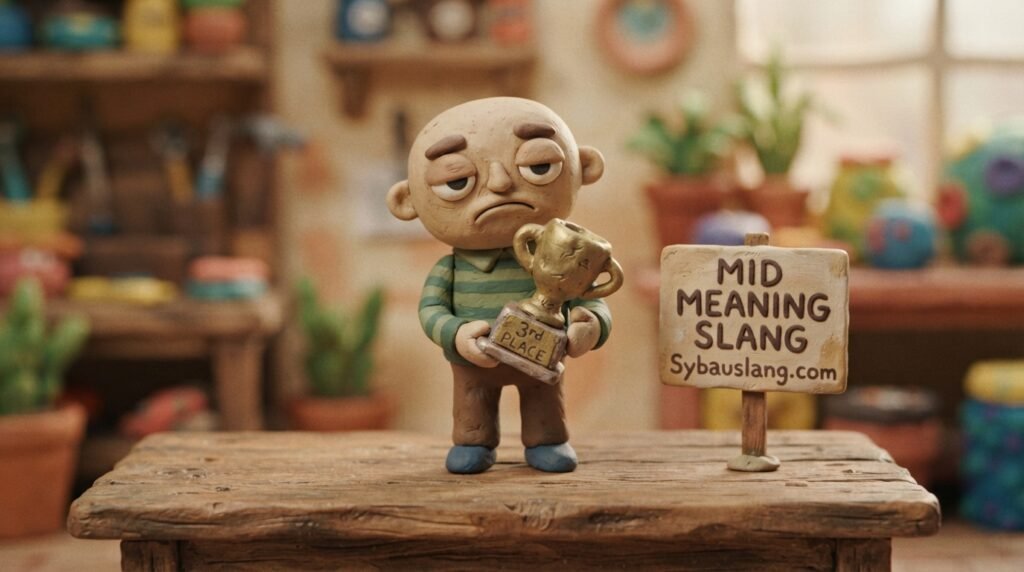
Think of it as the slang version of a shrug emoji. If a movie is “mid,” it’s watchable but forgettable. If food is “mid,” you’d eat it again but you’re not telling your friends about it. If someone’s outfit is “mid,” it’s fine, nothing special.
The word actually comes from “middle” — as in middle of the road, middle of the pack, right in the center between good and bad.
Gamers get a lot of credit for popularizing it (it was used a ton in League of Legends and gaming Discord servers to describe average plays or average players), and from there it leaked into everyday conversation, then exploded on TikTok and Twitter/X around 2021-2022.
Why “Mid” Hits Different Than Just Saying “Average”
Here’s the thing I noticed once I started paying attention — nobody actually uses the word “average” anymore in casual conversation. It sounds too formal, too much like a teacher grading a test.
“Mid” feels more casual, a little dismissive, and honestly kind of funny. It’s short, punchy, and works as both a noun and an adjective.
You can say “that was mid” or just “mid” as a one-word reaction, and everyone gets it instantly.
I’ve started noticing it everywhere once I knew what to look for:
- Under YouTube video comments: “video was mid ngl”
- In gaming chat after a match: “that team comp was so mid”
- On restaurant reviews from younger folks: “food mid, service was actually good tho”
- Reacting to a new song drop: “not bad but kinda mid compared to their last album”
Once you start seeing it, you can’t unsee it.
My Own “Mid” Learning Curve (Aka Mistakes I Made)
I’ll be honest, I misused this word a bunch of times before I got the hang of it. Here’s what tripped me up:
Mistake 1: Using it for things that are actually bad. I called a phone charger “mid” when it straight up stopped working after two days. My nephew corrected me — that’s not mid, that’s just trash. Mid means it works fine, just nothing impressive. Big difference.
Mistake 2: Using it as a compliment by accident. I once told a coworker her presentation was “mid” thinking it sounded neutral-ish, almost polite. She was not thrilled. Turns out calling something mid, even gently, still reads as an insult because it implies you expected more and got nothing memorable.
Mistake 3: Overusing it until it lost meaning. For like a week I called everything mid — my breakfast, the weather, a Netflix show, my own outfit. My friend pointed out I sounded like I was bored of literally everything. Lesson learned: it works best as an occasional reaction, not your default vocabulary setting.
How to Actually Use “Mid” the Right Way
If you want to use this word naturally instead of sounding like you just learned it from a listicle (no offense to this article), here’s a simple breakdown.
Step 1: Reserve it for genuinely average things Not bad, not good. If something is actively disappointing, don’t call it mid — that undersells how bad it was. Save “mid” for stuff that’s just forgettable.
Step 2: Use it as a quick reaction, not a full explanation The whole appeal of “mid” is that it’s short. You don’t need to explain why something is mid, that’s kind of the point. It’s a vibe, not a review.
Step 3: Know your audience Using “mid” in a formal work email is going to land weird. Use it in texts, casual chats, gaming lobbies, social media comments — places where slang naturally lives.
Step 4: Pair it with tone, not just text When spoken out loud, “mid” often comes with a slight pause and a flat tone — like “…it was mid” — which adds to the underwhelmed vibe. In text, people often lowercase it or skip punctuation entirely for the same casual, unbothered effect.
Real Examples From Everyday Conversations
Just to make this crystal clear, here’s how “mid” actually shows up in real conversations I’ve seen or been part of:
- Friend recommending a show: “it’s mid honestly, watch something else”
- Reacting to a new phone release: “camera’s better but everything else feels mid”
- After a first date: “he was nice but kinda mid, no spark”
- Reviewing a gym: “equipment’s decent, mid crowd though, gets packed fast”
Notice how it’s never used for extremes. Nobody says a five-star meal is mid, and nobody says food poisoning is mid either. It lives strictly in that in-between zone.
Common Mistakes People Make With “Mid”
Since I learned this the clumsy way, let me save you the trouble:
- Don’t confuse it with “meh.” They’re close cousins but not identical. “Meh” is more about not caring either way. “Mid” is specifically about quality being average.
- Don’t use it for people’s personalities in serious conversations. It comes off harsh and dismissive if used carelessly about someone’s character rather than a product, show, or experience.
- Don’t force it into older or more formal social circles expecting the same reaction you’d get from friends your age. Context really matters with slang like this.
- Don’t assume it translates the same everywhere. Slang shifts fast, and by the time you’re reading this, there might already be a newer word replacing it in certain online circles. Always read the room.
Where This Word Might Be Headed
Slang has a shelf life, and “mid” has already been around long enough that some circles consider it slightly overused or “boomer-coded” among the very online teen crowd (yeah, that phrase exists too now).
But it’s still widely understood and used across platforms like TikTok, X, Discord, and everyday texting, so you’re not going to sound outdated using it in 2026.
That said, if you’re a parent, teacher, or just someone trying to keep up with how younger people talk, at least now you won’t be as lost as I was standing in my kitchen wondering why my biryani got roasted.
Honestly, once you understand it, “mid” becomes kind of a useful word. It fills a gap — there wasn’t really a short, casual way to say “this is fine but nothing special” before it caught on. Now there is, and it’s stuck around for a reason.
FAQ’s
What does “mid” mean in slang?
“Mid” means something is average, mediocre, or less impressive than expected. It is often used when someone thinks something is okay but not particularly good.
Is “mid” a bad word?
No, “mid” is not a swear word or offensive term. However, calling something “mid” can sound dismissive or mildly insulting, especially when someone really likes it.
What does “mid” mean on TikTok?
On TikTok, “mid” is commonly used to describe content, music, movies, food, or trends that people consider ordinary or overhyped.
Can “mid” be used as a compliment?
Usually, no. “Mid” generally suggests that something is average rather than excellent. However, the tone and context can sometimes make it playful or humorous.
What is an example of “mid” in a sentence?
An example is: “Everyone said the movie was amazing, but I thought it was mid.” This means the person found the movie average or not very impressive.
Conclusion
Mid meaning slang is a simple way to describe something that feels average, mediocre, or less impressive than expected.
Instead of saying that a movie, song, meal, outfit, game, or experience is completely bad, someone may call it “mid” to suggest that it is simply nothing special.
The term has become especially common in online conversations, social media comments, texting, and platforms such as TikTok.
Its meaning is usually easy to understand from context, but the tone can vary. Sometimes “mid” is used seriously to criticize something, while other times people use it jokingly with friends.
Understanding this slang term can make online conversations easier to follow, especially when people discuss popular trends or viral content.
If someone says, “That song is mid,” they are generally saying that the song is okay but does not deserve all the hype. In short, “mid” means average or mediocre in modern slang.
It is a casual expression that helps people quickly communicate that something is neither terrible nor amazing, but somewhere in the middle.